
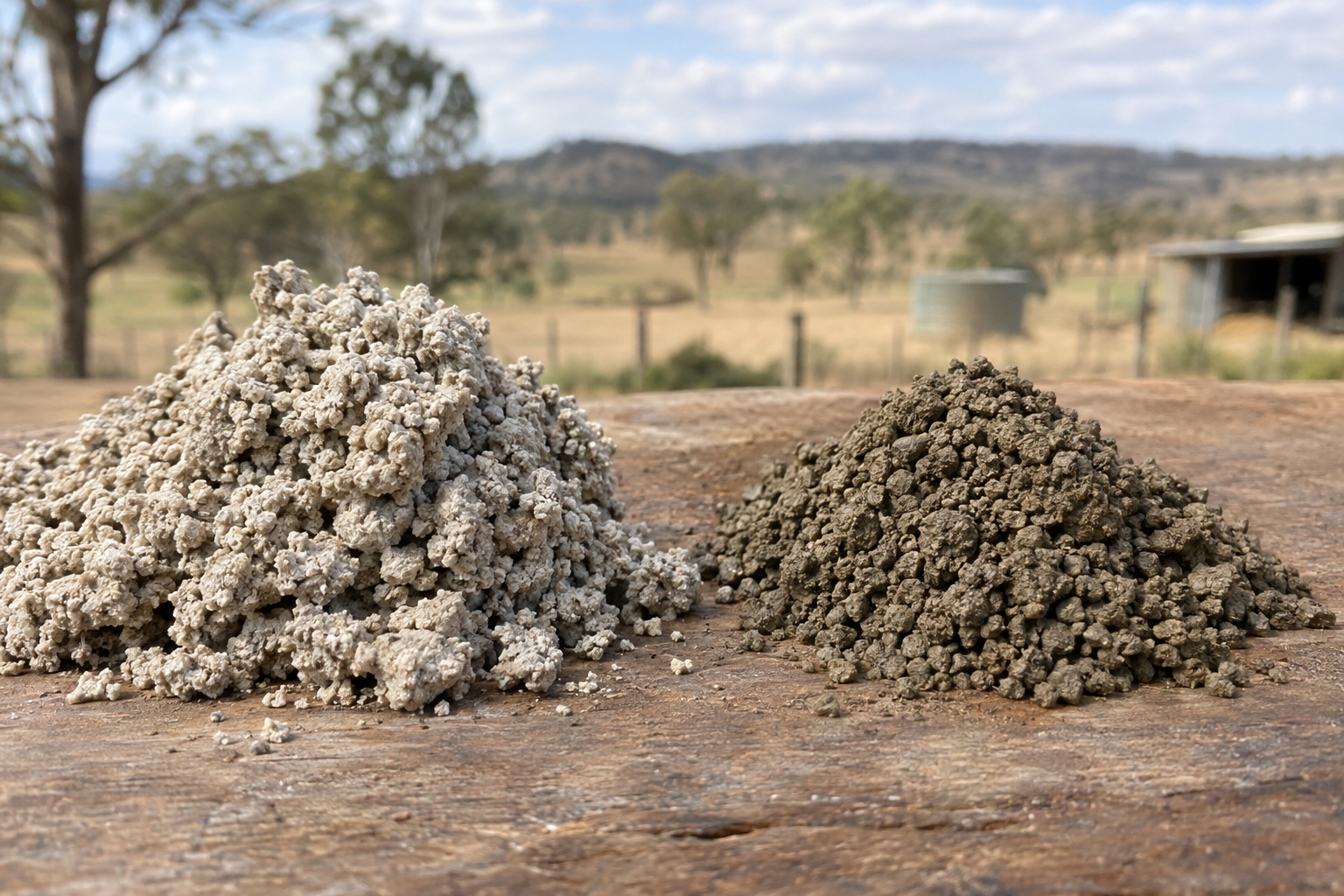
Quick answer: Use sodium bentonite, not calcium bentonite, to seal a dam. Sodium bentonite swells to many times its dry volume when wet and can reduce seepage in suitable, properly installed soil treatments; calcium bentonite swells very little. Bentonite Pro supplies fines in 1.2 tonne bulk bags and uses a recommended 30 kg/m² rate, subject to site assessment.
Sodium vs calcium bentonite: which one seals a dam?
Bentonite is named for the dominant exchangeable cation in its clay. Sodium bentonite has a high swelling capacity in water, while calcium bentonite has negligible swelling capacity, and only sodium bentonite should be used for pond or reservoir sealing, according to University of Missouri Extension. Alabama Cooperative Extension and the US Southern Regional Aquaculture Center’s Renovating Leaky Ponds fact sheet give the same advice.
| Sodium bentonite | Calcium bentonite | |
|---|---|---|
| Swelling in fresh water | High, many times its dry volume | Low to negligible |
| How it reduces seepage | Swells into soil pores to form a low permeability layer | Fine particles, but little swelling to close pores |
| Dam and pond sealing | Recommended by extension guidance | Not recommended |
| Soda ash “activated” versions | Not applicable | Lab tests found lower water holding and higher permeability than natural sodium bentonite |
| Common other uses | Drilling fluids, clay liners, cut off walls | Absorbents, foundry binders, clarifying |
The activated calcium finding and the effect of water quality come from research published in Engineering Geology, which also reported that bentonite not prehydrated with fresh water swells very little or not at all in contaminated water. That is one reason to check salinity and the cause of the leak before choosing any treatment; the leaking dam repair quiz walks through those checks.
Bentonite Pro supplies natural sodium bentonite fines. Ask any supplier for a specification sheet before you buy, and compare montmorillonite content, cation exchange capacity and swell index rather than relying on the word “bentonite” alone.
Why sodium bentonite for dam sealing?
Sodium bentonite is a swelling clay. When hydrated, it expands to several times its original volume and can reduce the permeability of suitable treated soils.
Bentonite can be used in suitable dam and pond treatments. It is not a universal substitute for repairing structural faults or for other lining systems; diagnose the cause of water loss first.
How does sodium bentonite actually seal a dam?
Hydrated bentonite occupies pore spaces within a properly prepared treatment, helping reduce seepage. Performance depends on soil and water conditions, installation and protection of the treated layer.
What application rate should I use?
Bentonite Pro’s recommended application rate is 30 kg/m². Confirm soil suitability, the cause of leakage and the installation method before ordering or starting work. This recommended rate is not a rate specified in the product sheet or a universal guarantee of sealing. Our product is fines, not the separate granular grade. See How It Works for mixed and pure blanket methods and their different compaction sequences.
What makes a high-grade sodium bentonite?
The product specification sheet gives typical montmorillonite content above 90%, cation exchange capacity above 90 meq/100 g and a swell index of 7 to 16 mL/2 g on an as-is basis. Our fines are nominally below 1.25 mm. The swell index is not a dry-volume expansion ratio, and purity alone does not establish whether a treatment suits a particular dam.
How much bentonite will I need?
| Surface area | Bentonite needed (at 30 kg/m²) |
|---|---|
| 200 m² | 6,000 kg (6 tonnes) |
| 500 m² | 15,000 kg (15 tonnes) |
| 1,000 m² | 30,000 kg (30 tonnes) |
Measure the total surface area you’re sealing (floor plus walls), multiply by 30 kg/m², and add a 5 to 10% preliminary allowance, subject to confirming site conditions and the treated area.
Choosing the right amount for your job
Bentonite Pro supplies sodium bentonite fines in 1.2 tonne bulk bags, delivered across NSW, VIC and QLD. See How It Works for installation guidance and limitations.
Can bentonite be applied in stages?
Stage the work only under a site-specific plan that maintains a continuous treated layer and protects completed areas from erosion and disturbance. Compact each section as required by the chosen method; do not assume that separate, unconnected patches will seal the whole dam.
Does the application rate change for ornamental or garden ponds?
Bentonite Pro uses the same recommended 30 kg/m² rate for preliminary pond quantities, subject to checking site suitability and the treatment method. The current product is supplied in 1.2 tonne bulk bags; contact us to discuss whether that pack size suits your job.
How long does a correctly applied bentonite seal last?
Service life depends on soil and water conditions, installation quality and protection from erosion, roots, burrowing animals, stock traffic and drying. A correctly selected and installed treatment can provide ongoing seepage control, but the product specification does not establish a guaranteed service life.
Not sure which quantity suits your dam or pond? Get in touch with Bentonite Pro.
For the price per tonne, coverage per bag and how freight to your address is worked out, see the sodium bentonite delivered price guide.