
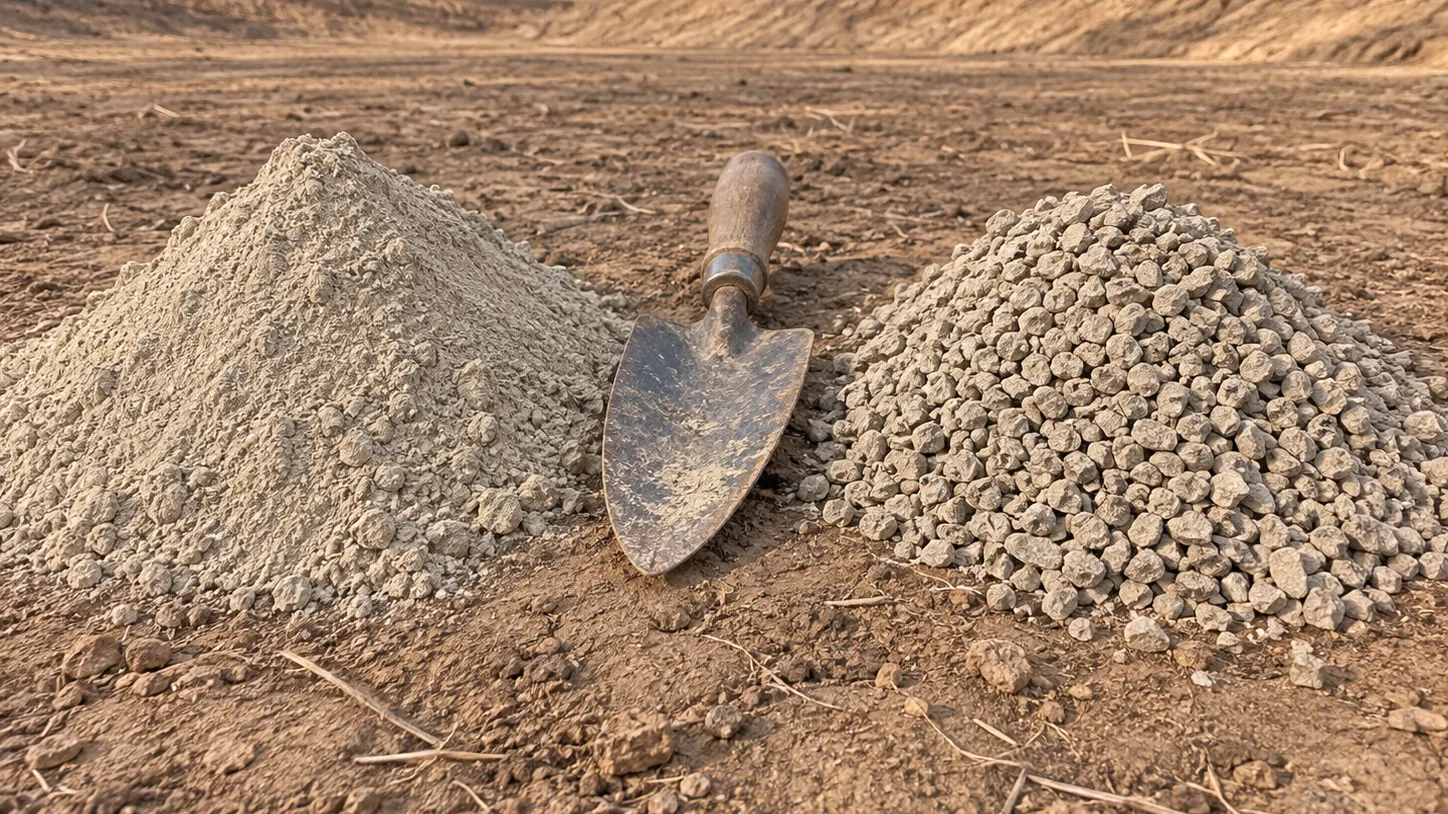
Short answer: Fine vs granular sodium bentonite comes down to the installation method. US extension and NRCS guidance pairs fine or pulverised bentonite with blankets placed on a drained floor, and coarse granular bentonite with sprinkling onto water. Granular is easier to handle, but evenly spread fine powder needs less material for the same permeability reduction.
The grade on a bentonite order is a particle-size range, not a quality rating. Choosing between fine and granular sodium bentonite starts with how the material will be placed: worked into dry soil on a drained floor, laid as a covered layer, or scattered onto water that cannot be drained. This guide sets out what each grade means on a specification sheet, what published guidance says about each, and where Bentonite Pro’s own product sits.
Sodium bentonite is a montmorillonite clay with exchangeable sodium cations that swells when wet. A particle-size grade is the range of sieve openings that most of the product passes or is retained on, measured by weight.
Fine vs granular sodium bentonite: what the grades mean
How does a specification sheet define each grade?
The Big Ditch Bentonite specification sheet lists two grades from the same deposit. The figures below are typical values stated on that sheet. Both grades have the same listed moisture content and bulk density; only the particle size differs.
| Property | Fine grade | Granular grade |
|---|---|---|
| Nominal particle size | Below 1.25 mm | 1 to 4 mm |
| Upper size limit | 5% max retained on 2 mm | 5% max retained on 4 mm |
| Lower size limit | 15% max passing 75 µm | 5% max passing 425 µm |
| Moisture content | 12 to 20% | 12 to 20% |
| Bulk density (t/m³) | 1.2 to 1.4 | 1.2 to 1.4 |
Bentonite Pro supplies the fine grade only, in 1.2 tonne bulk bags. The granular grade on the sheet is not a stocked product.
What do US engineering standards call fine and granular?
The US Natural Resources Conservation Service (NRCS) uses tighter definitions. Its National Engineering Handbook, Part 645, Chapter 9 describes fine powder bentonite as having 80% passing the No. 200 sieve. It describes coarse granular bentonite as having less than 15% passing the No. 200 sieve and less than 15% retained above the No. 20 sieve.
A No. 200 sieve has a 75 µm opening and a No. 20 sieve has an 850 µm opening, according to the ASTM E11 sizes in Gilson’s sieve size guide.
Is Bentonite Pro’s fine grade a powder?
No. Our fine grade allows at most 15% passing 75 µm, while the NRCS fine powder has 80% passing the same sieve. On that measure our fines are much coarser than an NRCS fine powder. The sheet does not report how much is retained above 850 µm, so it cannot be classed against the NRCS granular definition either. Treat the NRCS comparisons below as guidance on the two forms, not as test results for our product.
Which grade suits which installation method?
Published farm-dam guidance links the grade to the method. The Texas A&M AgriLife Extension guide to sealing ponds with bentonite places a fine or pulverised grade on the bottom for the blanket method. It says the sprinkle method requires coarse bentonite, either crushed or granular grade.
| Method | Dam condition | Grade named in guidance | Reliability noted in guidance |
|---|---|---|---|
| Mixed blanket | Emptied and dried | Fine or coarse, with the rate set for the form used (NRCS) | May be less effective than a pure blanket if mixing is uneven (Texas A&M) |
| Pure blanket | Emptied and dried | Fine or pulverised grade (Texas A&M) | Usually more effective than sprinkling when done correctly (Texas A&M) |
| Sprinkle or broadcast | Full; cannot be drained | Coarse, crushed or granular grade (Texas A&M) | “At best hit and miss” (NSW DPI) |
Why does fine bentonite need less material?
The NRCS handbook states that when evenly distributed, it takes less fine bentonite than coarse bentonite to reach the same reduction in permeability. It also states that coarse bentonite is easier to handle and distribute and easier to incorporate into wet soils. Permeability is the rate at which water can pass through soil.
NRCS says the application rate should be specified for the form of bentonite used. Where both fine and coarse forms are allowed, a rate should be given for each.
Does granular bentonite mix evenly into soil?
Not always. The NRCS handbook warns that granular bentonite tends to segregate to the bottom of the lift with each pass of the tiller. If granular bentonite is used, NRCS limits mixing to two passes: the first at about half the lift depth, the second at full depth, ideally at right angles to the first.
Can fine bentonite be spread on a windy day?
NRCS says fine powder bentonite should not be applied in windy conditions. Coarse granular bentonite may be applied in light winds, though NRCS advises waiting for the wind to drop where possible. It also recommends protecting workers from breathing fine powder and keeping bentonite dry and covered until it is spread.
Should granular bentonite be broadcast onto a full dam?
Granular is the grade named for the sprinkle method, but the method itself is the weak link. The NSW DPI Leaking farm dams guide describes broadcasting bentonite on the water surface as “at best hit and miss” and does not recommend it because success cannot be assured. Texas A&M adds that sprinkling is less effective than the blanket methods and is not recommended where livestock wade in the water.
Using fine-grade sodium bentonite on a drained dam
NSW DPI describes two drained-dam methods. A mixed blanket on light or loam soils works bentonite into the top 150 to 200 mm of soil before roller compaction. A pure blanket on heavy soils is covered with at least 100 mm of site soil, or at least 450 mm where stock have access, then compacted. Our How It Works guide sets out both sequences.
The NRCS handbook adds practical points for the mixing stage:
- Spread the bentonite in two applications, half at right angles to the other.
- Use a drop-type spreader; avoid rotary spreaders, which give inaccurate rates and dust.
- Apply to soil 1 to 2% below optimum moisture so the bentonite does not clump.
- Mix to the full lift depth and check the bentonite is evenly distributed.
- Compact before the bentonite starts to hydrate.
- Finish spreading, mixing and compaction on the same day.
Bentonite Pro’s recommended application rate is 30 kg/m². This is our ordering figure, not a rate set by NRCS, NSW DPI or the specification sheet. The bentonite quantity calculator converts a treatment area into tonnes and whole 1.2 tonne bags. Grade is only one variable: check soil suitability and the sodium vs calcium difference before you order.
Frequently asked questions
Is granular bentonite better quality than fine bentonite?
No. Grade describes particle size, not purity. The specification sheet lists one set of typical montmorillonite, swell index and chemical values, with separate particle-size limits for each grade.
Can I swap a granular rate for a fine rate?
Not directly. NRCS says proportioning may differ between fine powder and coarse granular bentonite, and the rate should be specified for the form used. If a design or quote gives a rate, confirm which grade it assumes.
Does Bentonite Pro sell granular bentonite?
No. Bentonite Pro supplies sodium bentonite fines in 1.2 tonne bulk bags for drained mixed and pure blanket treatments, delivered across NSW, VIC and QLD. If your dam cannot be emptied, arrange a site assessment before ordering any grade.

Written by Angus Hughson, CEO, Big Ditch Dam Building Company. General information only; the selection and design of a dam treatment require site-specific assessment.
Weighing fine vs granular sodium bentonite for your dam? Contact Bentonite Pro to confirm the grade, quantity and method before you order.