
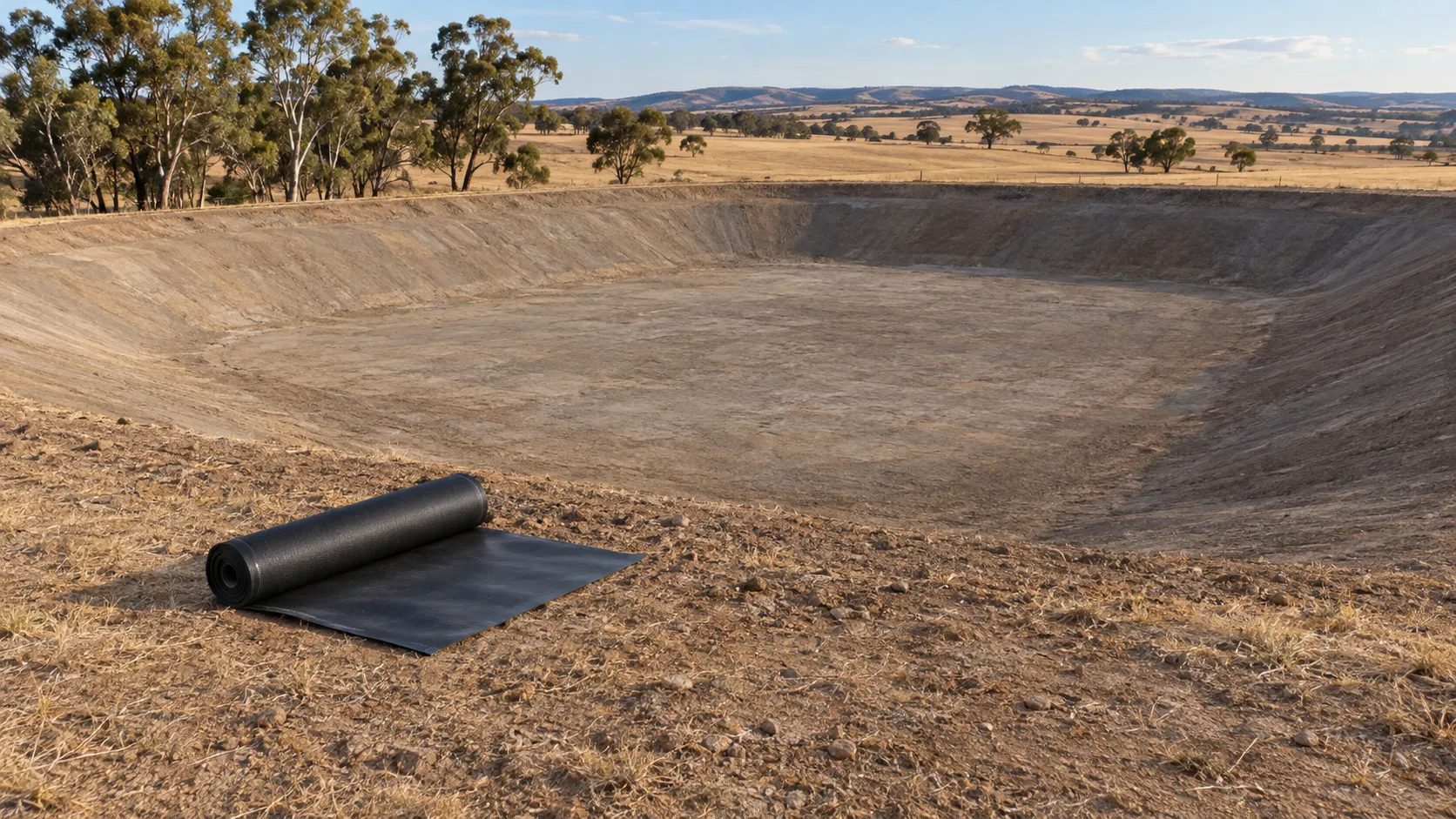
Short answer: Bentonite and synthetic liners need a whole-project comparison, not just a price per square metre. Comparing bentonite vs synthetic liners means checking soil suitability, preparation, installation, protection and repair access. Neither option guarantees a fixed lifespan or solves every leak. Obtain site-specific scopes before choosing between a bentonite treatment and an HDPE or EPDM membrane.
A low material price can become an expensive choice if the quoted system omits work the dam needs. Start by identifying the cause of water loss, the area requiring treatment and whether the dam can be emptied. Comparing two prices without matching those assumptions can put a supply-only bentonite order alongside a fully installed membrane, or the reverse. Neither comparison tells you which finished system suits the site.
A bentonite treatment is a prepared soil treatment using swelling clay to reduce seepage. A synthetic liner is a manufactured membrane laid over a prepared supporting surface to contain water. HDPE is high-density polyethylene, a plastic used in some commercial liners; EPDM is a synthetic rubber used in other lining systems. The membrane, its joints and its connections must be considered together, not as interchangeable sheets.
Bentonite vs synthetic liners: what are you comparing?
Does either option remove the need for site assessment?
No. A liner choice cannot replace diagnosis of the loss or assessment of the dam’s condition. The NSW DPI Leaking farm dams guide advises checking other sources of water loss before assuming leakage and describes several repair methods. It also explains that commercial membranes rely on continuous backing for support. A membrane should not be treated as a structural repair to an unstable embankment, and buying bentonite does not establish that a soil treatment will suit the site.
Ask an assessor to distinguish seepage through the basin from problems involving pipes, exposed permeable material or the embankment. Seepage is water moving through soil or other porous material. Record water use and inflows as part of the assessment. Where structural damage or safety concerns are present, obtain dam-safety advice before planning excavation, draining or treatment.
What belongs in each installation scope?
A scope should identify the chosen method, treatment boundary, preparation, materials and acceptance checks. The table below is a quote-review checklist, not a design specification. Synthetic-liner requirements must come from the selected product supplier and site designer; one manufacturer’s instructions should not be transferred to a different membrane.
| Question | Bentonite treatment | HDPE or EPDM membrane |
|---|---|---|
| What is being supplied? | Specified quantity of sodium bentonite fines, plus the agreed installation work. | Named membrane product, grade, thickness and the required joint and connection system. |
| What preparation is included? | Draining, drying, clearing, soil preparation and the selected mixed or pure blanket method. | Firm, even supporting surface free of damaging protrusions, with protection specified for that product and site. |
| How is continuity checked? | Treatment boundary, distribution, mixing or cover sequence, and compaction records. | Panel layout, joints, penetrations and edge anchorage, with the supplier’s inspection and testing requirements. |
| What protects it in use? | Required cover and a plan for stock, erosion, refilling and later maintenance. | Product-specific protection against damage, with permitted exposure and access conditions stated. |
| What happens if loss returns? | Assessment of the cause and treatment condition before any additional material is ordered. | Inspection and a compatible repair method, with access and any draining requirements identified. |
How should you compare installed costs?
What does Bentonite Pro’s material price include?
Bentonite Pro’s price is $295 plus GST per tonne, supplied in whole 1.2 tonne bags at $354 plus GST a bag. Freight is separate and calculated by address for NSW, VIC and QLD.
The current 1.2 tonne sodium bentonite fines bulk bag is a material purchase, not a complete installed dam lining. A project comparison must add the assessed preparation, handling, equipment, labour, protection and refilling work. Ask whether unloading equipment, access improvements and any removal of unsuitable material are included in each contractor’s quote.
Bentonite Pro’s recommended application rate is 30 kg/m². Confirm soil suitability, the cause of leakage and the installation method before ordering or treatment; this rate is not specified by the product sheet or endorsed by NSW DPI.
At that recommended rate, the unrounded material calculation is $8.85 plus GST per square metre before freight. Whole-bag rounding can increase the actual product cost per square metre, and neither figure is an installed price or a guarantee of sealing.
How does a 500 m² example work?
For an assessed treatment area of 500 m², including the floor and relevant sloping walls, the calculation is 500 × 30 = 15,000 kg. Divide by 1,200 kg per bag to obtain 12.5 bags, then round up to 13 whole bags. Those bags supply 15,600 kg and cost $4,602 plus GST before freight and installation. This example assumes no additional allowance and is not a quote for a particular dam.
A stated allowance of 5 to 10% on the 15,000 kg requirement brings the order to 14 whole bags. At the current bag price, that is $4,956 plus GST before freight and installation; confirm the allowance against site conditions.
One 1.2 tonne bag provides material for 40 m² at the recommended rate before any allowance. That is calculated coverage, not guaranteed sealed area.
What should the membrane quote include?
Ask for the total installed price for the same measured basin and intended use. Require the quote to identify membrane area, allowances for joints and anchorage, ground preparation, protective layers where specified, installation, connections, inspection and repair provisions. A membrane roll area is not automatically the usable lined area. Do not compare a sheet-only price with the bentonite project’s finished cost, or assume a generic online membrane price applies to your dam.
Keep GST, freight and exclusions visible in both quotes. Include the practical cost of taking the dam out of service and ask who is responsible for work discovered after draining. This guide does not assign a universal installed price to HDPE or EPDM because no product-specific, site-matched quotation has been established. A cheaper headline price is not enough to rank the completed systems.
Which installation details affect durability?
How does the bentonite method change the work?
A mixed blanket incorporates bentonite into the existing soil; a pure blanket retains it beneath protective soil cover. The drained-dam methods require emptying and drying the dam, clearing rocks and vegetation, and assessing the site before work. For suitable light or loam soils, a mixed blanket is distributed, mixed into the upper 150 to 200 mm and then compacted with a roller. It is not the same sequence as a pure blanket.
For a pure blanket on suitable heavier soils, spread bentonite over the prepared surface without mixing it into the base. Cover with at least 100 mm of site soil, then compact the covered treatment with a roller. Increase cover to at least 450 mm where stock have access. Protective cover comes before roller compaction, as described in the NSW DPI method guidance; its generic rates are not Bentonite Pro’s recommended rate.
Refill gently to avoid disturbing the treated surface, then monitor performance. Staged work needs a site-specific plan that maintains continuous treatment and protects completed areas against disturbance and erosion. Unrelated patches or successive layers cannot be assumed to form a reliable seal, and no fixed hydration or sealing time is promised here.
Why do membrane joints and support matter?
Joints connect adjacent membrane panels; penetrations are places where pipes or other fittings pass through the lining. NSW DPI identifies continuous support, a prepared surface without damaging protrusions and secure anchorage as requirements for commercial liners. The selected supplier must specify how those requirements are met at your site. Do not assume that placing a sheet over rough ground removes preparation costs.
EPDM and HDPE should not be treated as one jointing system. For example, Elevate’s EPDM seam guidance describes its own primer-and-tape system and seam inspection methods. That manufacturer-specific example shows why the quote should name the jointing system and quality checks; it is not an instruction to use those products or methods on another liner.
Can you choose by a promised number of years?
A generic lifespan claim is not a substitute for the product’s written conditions and the installation plan. For a membrane, ask what the warranty covers, who provides it, what exposure and maintenance conditions apply, and whether installation work is included. For bentonite, do not turn a material test into a service-life promise. Both options need a practical plan for protection, inspection and investigation if water loss returns.
The Big Ditch Bentonite specification sheet lists typical material properties for general information, not guaranteed specifications. Its typical swell index of 7 to 16 mL/2 g is on an as-is basis; it is a test value, not an expansion multiplier or a prediction of years of sealing.
Frequently asked questions
Is bentonite always cheaper than a synthetic liner?
No universal cost ranking follows from the material price. Compare site-matched installed scopes, including preparation, freight, handling, protection and future repair access. The worked bentonite example above is a product calculation, not evidence that it is cheaper than every membrane installation.
Can a membrane fix an unstable dam wall?
Do not treat a containment membrane as a structural repair. NSW DPI explains that commercial liners rely on continuous backing for support. An unstable embankment requires professional assessment before a lining method is selected.
Can bentonite be added without emptying the dam?
Do not rely on water-surface broadcasting or slurry addition as an assured repair. NSW DPI describes broadcasting as “at best hit and miss” and does not recommend it because success cannot be assured. If the dam cannot be emptied, arrange a site assessment rather than applying a dosing recipe.

Written by Angus Hughson, CEO, Big Ditch Dam Building Company. General information only; the selection and design of a dam treatment require site-specific assessment.
Comparing bentonite vs synthetic liners for your dam? Contact Bentonite Pro to discuss suitability, quantities and the scope needed for a useful comparison.