Category: Bentonite Guides

  • Bentonite Sealing Mistakes: 7 Checks Before You Start

    Bentonite Sealing Mistakes: 7 Checks Before You Start

    Short answer: Bentonite sealing mistakes include treating an undiagnosed leak, measuring only the water surface, confusing installation methods and leaving treatment unprotected. Assess the soil and leak first, calculate the full treatment area, and follow the selected method in order. Adding more material cannot compensate for an unsuitable site or a disrupted treatment layer.

    A bentonite order is only one part of a dam repair. Before arranging bags and machinery, check that the proposed treatment addresses the actual problem and that the work can be completed without leaving gaps or disturbing finished areas. This checklist focuses on decisions that can go wrong before, during and after installation, rather than treating every falling waterline as a reason to buy material.

    Sodium bentonite is a clay that swells to several times its original volume when wet and can reduce water movement through a suitable treated soil layer. A blanket is a continuous treatment layer across the area selected for sealing. A mixed blanket incorporates bentonite into the soil; a pure blanket keeps it as a separate layer beneath protective soil cover.

    Which bentonite sealing mistakes should you avoid?

    Are you treating a leak before checking its cause?

    A falling water level is not enough to specify bentonite treatment. The NSW DPI Leaking farm dams guide says other sources of water loss should be checked when a leak is suspected. Record pumping, outlet use, weather and water-level changes, then have the suspected leakage assessed. Bentonite should not become a substitute for investigating a damaged pipe, an unsuitable foundation or a problem in the dam wall.

    Keep the decision separate from the purchase: first establish whether a drained bentonite treatment is suitable, then select its boundary and method. If the dam wall is cracking, slumping or otherwise changing, obtain professional advice rather than experimenting with a sealing recipe. An online checklist cannot establish structural safety or prescribe excavation around a suspect wall.

    Have you measured the floor and relevant sloping walls?

    Use the total surface area that will actually be treated, not just the visible water surface or a length-by-width sketch of the opening. Relevant sloping walls contribute area, and irregular basins need a site-specific measurement. Ask the assessor to identify the treatment boundary before calculating material. Buying from a convenient but incomplete area estimate can leave the job short even when the multiplication is correct.

    Bentonite Pro uses 30 kg/m² as its recommended rate. Confirm soil suitability, the cause of leakage and the installation method before ordering; this rate is not a specification-sheet value or a rate attributed to NSW DPI.

    Bentonite Pro supplies 1,200 kg bags, so one bag provides material for 40 m² at the recommended rate before an allowance. That is calculated coverage, not a guarantee of sealing.

    Have you rounded the order up to whole bags?

    Round up after converting the required mass to bags. A 500 m² treatment area needs 15,000 kg at 30 kg/m²; dividing by 1,200 kg gives 12.5 bags, so the minimum order is 13 whole bags before an allowance. Do not round down to 12 bags or describe the requirement as a range that includes an insufficient quantity.

    For the same 500 m² example, an explicitly stated 5 to 10% allowance requires 14 whole bags. Confirm the allowance against site conditions rather than assuming that extra material removes the need for accurate measurement or suitable installation.

    Bentonite Pro’s 1.2 tonne sodium bentonite fines bulk bags are priced at $295 plus GST per tonne, supplied in whole bags at $354 plus GST each. Freight is separate and calculated by delivery address for NSW, VIC and QLD; compare the supplied quantity and freight, not an unrounded tonne estimate alone.

    Are you confusing a mixed blanket with a pure blanket?

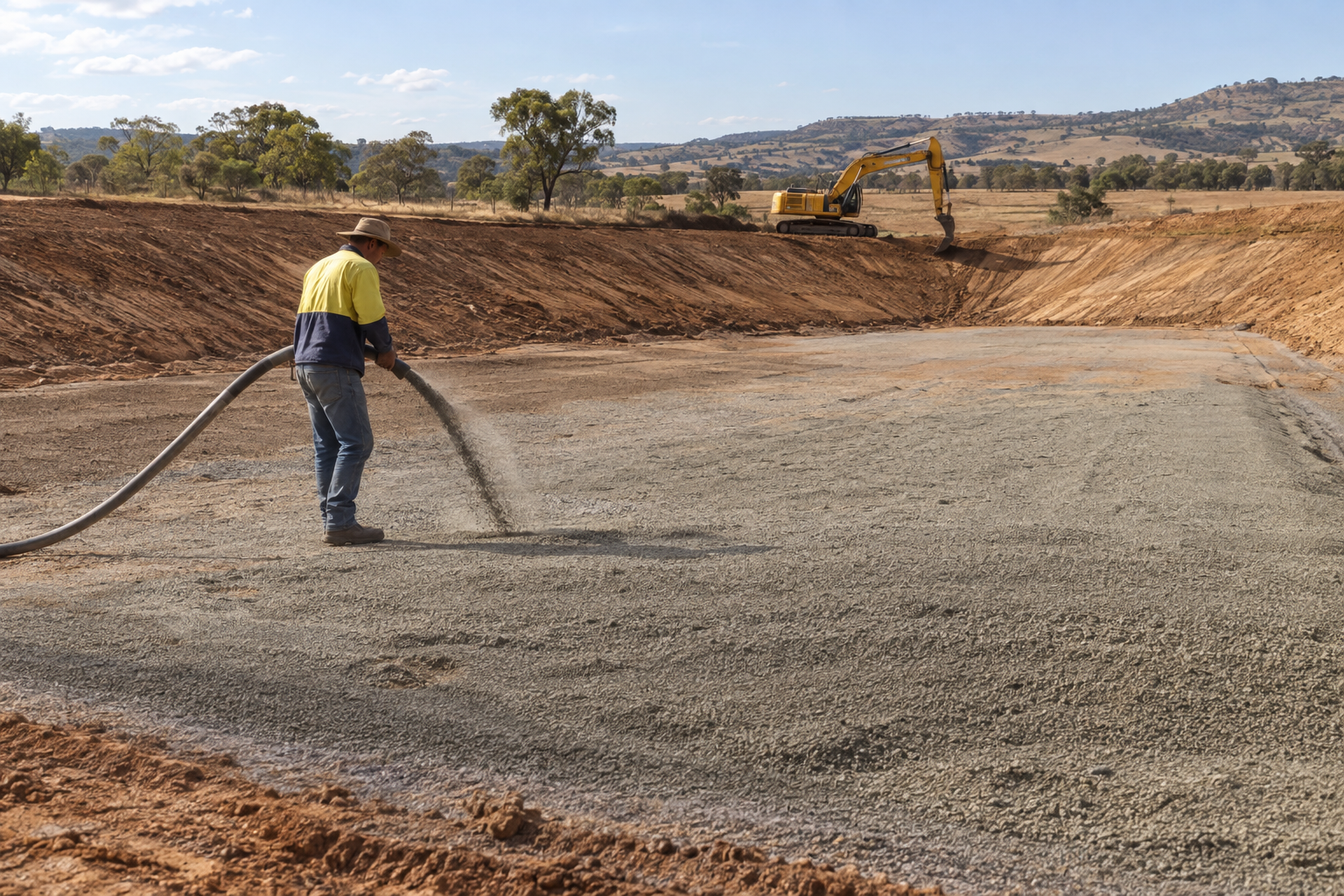
    These are different installation sequences, not interchangeable names. Both drained-dam methods require emptying and drying the dam, clearing rocks and vegetation, and assessing the site before work. Bentonite Pro’s dam-sealing method guidance distinguishes suitable light or loam soils from suitable heavier soils. Select the method before arranging equipment or starting to spread material, rather than changing the sequence halfway through the job.

    For a mixed blanket on suitable light or loam soils, prepare the soil, distribute bentonite, mix it into the upper 150 to 200 mm and then compact with a roller. NSW DPI describes this incorporation sequence in its mixed-blanket guidance; its generic method advice does not establish Bentonite Pro’s company application rate.

    Will a pure blanket be covered before roller compaction?

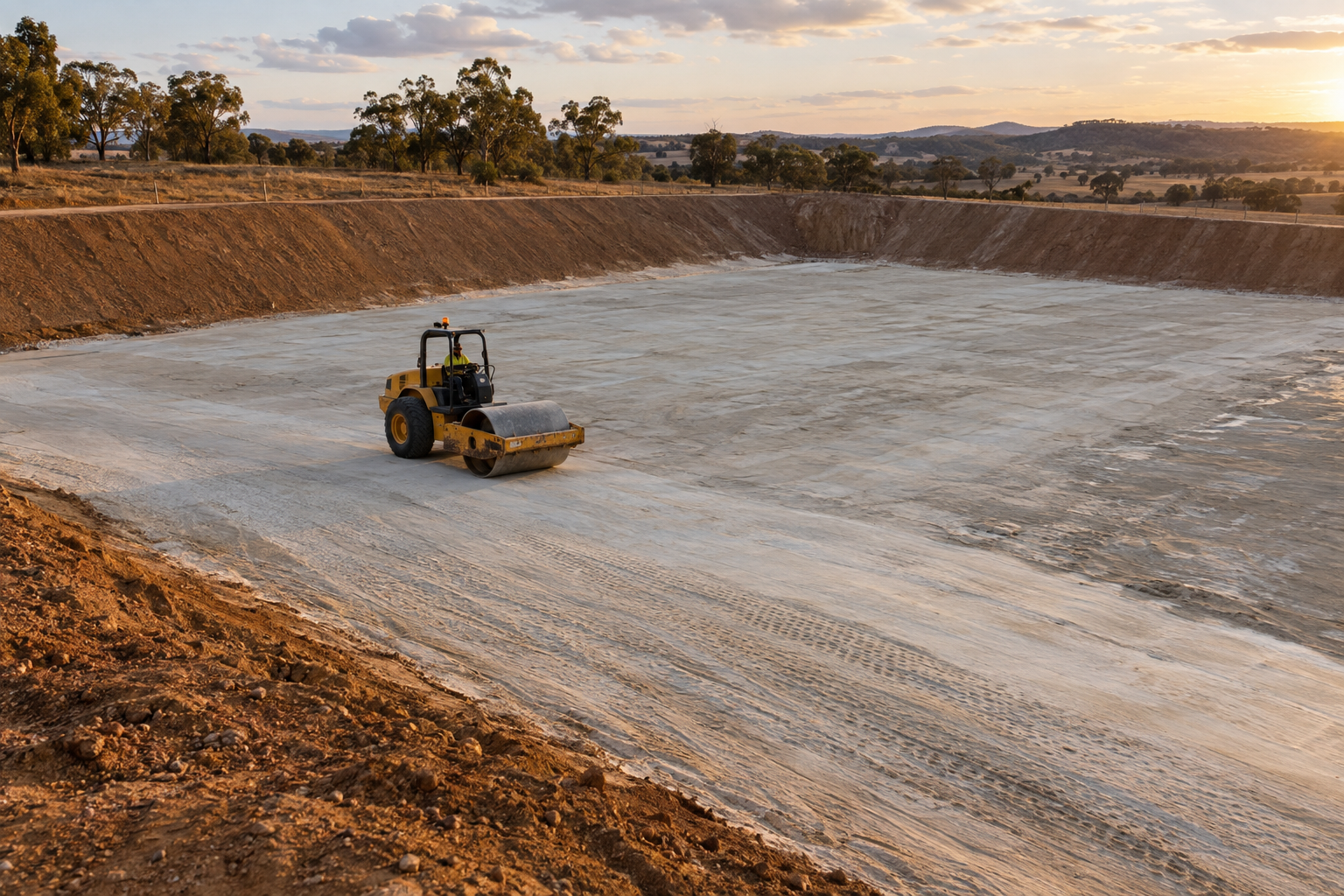
    For a pure blanket on suitable heavier soils, distribute bentonite over the prepared surface without mixing it into the base. Cover it with at least 100 mm of site soil, then compact the covered treatment with a roller. Increase the cover to at least 450 mm where stock have access. The NSW DPI pure-blanket guidance places protective cover before the final roller-compaction step.

    Do not confuse spreading the bentonite with finishing the treatment. Plan the protective soil, access and work sequence before spreading starts, so placing cover does not become an improvised task after machinery has crossed the exposed layer. The finished treatment must remain continuous and protected from disturbance and erosion; isolated patches or successive layers are not automatically equivalent to a complete sealing plan.

    Are you relying on broadcasting into a full dam?

    Do not treat water-surface broadcasting as an assured shortcut around draining and preparation. NSW DPI describes it as “at best hit and miss” and does not recommend it because success cannot be assured. If the dam cannot be emptied, arrange a site assessment instead of using a broadcast dosing recipe. Slurry addition, broadcasting, mixed incorporation and pure blankets are distinct techniques; material does not automatically find and seal the leak.

    Could refilling or later access disturb the treatment?

    Refill gently to avoid eroding or disturbing the treated surface, then monitor performance. Plan how water enters and how stock or machinery will be kept from damaging the work. Do not promise a fixed hydration time, a particular sealing date or a guaranteed lifespan. If work must be staged, have a site-specific plan for maintaining a continuous treatment rather than assuming separate patches will connect themselves.

    What should you confirm before work starts?

    Use the following checks as questions for the person assessing and installing the treatment. A completed checklist is not certification that a dam is suitable or safe; it helps identify missing decisions before material is spread.

    DecisionConfirm before proceeding
    Cause and suitabilityThe leakage assessment, soil suitability and reason for selecting bentonite.
    Treatment boundaryThe measured floor and relevant sloping walls, including any irregular areas.
    QuantityMass at 30 kg/m², whole-bag rounding and any separately stated allowance.
    MethodMixed incorporation followed by rolling, or a pure blanket covered before rolling.
    ProtectionCover, stock access, staged-work continuity and a gentle refilling arrangement.
    Follow-upWho will monitor water levels and assess unexpected loss or disturbance.

    What does the specification sheet actually establish?

    Bentonite Pro supplies high-purity sodium bentonite fines, not the separate granular grade. The current Big Ditch Bentonite specification sheet lists nominal fine-grade particle size below 1.25 mm and typical montmorillonite content greater than 90% on an as-is basis.

    Those are typical values for general information, not guaranteed specifications or evidence that a particular dam will seal. The sheet describes the material; it does not diagnose a leak, choose an installation method or guarantee a service life. Keep product selection, site assessment and construction decisions separate rather than treating a material property as a repair promise.

    Frequently asked questions

    Will adding more bentonite fix a failed treatment?

    Not necessarily. Have the cause of continued loss, soil suitability, method and condition of the treated surface checked first. Extra material cannot be assumed to correct a structural defect, an unsuitable treatment or damage to a finished layer.

    Does every bentonite method require mixing?

    No. Mixed blankets incorporate bentonite into soil before roller compaction. Pure blankets keep bentonite separate from the base and require protective soil cover before roller compaction. Choose the method through site assessment, not by combining instructions from both.

    Can I order before the treatment area is confirmed?

    You can prepare an estimate, but confirm suitability, method and the full treatment boundary before committing to an order. Keep assumptions visible, especially sloping-wall area, whole-bag rounding and any allowance. Do not describe a preliminary quantity as a guaranteed sealing requirement.

    Angus Hughson, CEO, Big Ditch Dam Building Company

    Written by Angus Hughson, CEO, Big Ditch Dam Building Company. This guide provides general information; the appropriate treatment requires a site-specific assessment.

    Want to avoid bentonite sealing mistakes before work starts? Contact Bentonite Pro to discuss the site, treatment method and preliminary quantity.
  • Signs a Dam Needs Resealing: What to Check

    Signs a Dam Needs Resealing: What to Check

    Short answer: A falling waterline alone does not prove your dam needs resealing. Check water use and evaporation, then look for persistent wet areas, new cracks, settlement or damage to the treated surface. Record what changes and arrange an assessment before ordering bentonite. Signs of structural distress need professional safety advice, not a routine sealing treatment.

    A seasonal inspection is a chance to collect useful evidence before deciding on repairs. Keep the question practical: has water loss changed, where is water appearing, and has the wall or treated surface changed too? For a farm pond with no raised wall, the water-level record still matters, while the inspection should reflect its actual construction.

    Seepage is water moving through soil or other permeable material. Resealing is work intended to reduce unwanted water movement through the storage’s treated surface; it is not a substitute for repairing an unsafe embankment, pipe or spillway.

    Not sure whether bentonite suits your dam? The leaking dam triage check takes four questions and tells you whether to plan a drained treatment, get the site assessed, or have the wall checked first.

    How can you tell whether a dam needs resealing?

    Does a falling water level prove there is a leak?

    No. The NSW DPI guide advises checking other losses, including evaporation and an accidentally open outlet valve, before diagnosing a leak. Its Leaking farm dams guide also makes clear that each site is different and general guidance does not replace qualified advice.

    Start a dated record from a fixed, safely accessible reference point. Note rainfall, pumping, stock-water use and outlet settings alongside the water level. Compare observations under similar operating conditions rather than treating one hot, windy day or a pumping session as proof of seepage. Do not apply an invented universal millimetres-per-day threshold to decide whether to reseal.

    Which visible changes should you record?

    Record changes to both the storage and the surrounding ground. Dams Safety NSW’s small-dams safety guide identifies water levels, seepage, sinkholes, lush growth, settlement and cracking as inspection points. It also calls for checks around the inlet, waterline, wall, spillway and immediately downstream.

    ObservationUseful recordNext decision
    Water level falling without an obvious explanationDates, level readings, rainfall, pumping and outlet useAsk for a water-loss assessment before specifying treatment.
    Wet or unusually green ground below the wallLocation, extent and photographs from a safe positionHave the possible seepage path assessed, rather than assuming a floor treatment will fix it.
    New cracks, uneven crest, slumping or a sinkholePhotographs and a description of changes, without entering suspect groundSeek prompt dam-safety advice. Do not treat this as a routine bentonite order.
    Exposed or disturbed areas on a previously treated surfaceLocation, visible disturbance and available repair historyHave the continuity and protection of the treatment checked.
    Obstructed or eroded spillwayLocation and photographs taken without entering flowing waterArrange maintenance or professional advice appropriate to the defect; resealing does not resolve spillway capacity.

    Use this table to organise observations, not to certify the dam as safe. If a dam is failing and people may be in danger, Dams Safety NSW directs owners to call 000 immediately and, where safe, warn affected neighbours. Do not delay an urgent response to finish a checklist or request a material quote.

    What should a seasonal inspection record contain?

    How can you make the observations useful to an assessor?

    A dated sequence is more useful than an unexplained photograph. Use the same safe viewpoints where possible, and separate what you saw from what you think caused it. Write “wet patch below the eastern wall” rather than “failed bentonite seal” unless the cause has actually been established. Send available construction and repair records with the observations.

    1. Record the date, water level, recent rain, pumping and outlet settings.
    2. Photograph the waterline and accessible banks from safe, repeatable positions.
    3. Mark suspected defects on a simple sketch without probing or excavating the wall.
    4. Note whether each feature is new, unchanged or visibly worsening.
    5. Provide repair history and ask the assessor which areas and soil conditions need investigation.

    Choose follow-up timing with the assessor according to the defect and risk. A scheduled seasonal check must not become a reason to wait when something changes suddenly. Keep people, vehicles and stock away from suspect ground, and do not improvise drainage or excavation around a potentially unstable wall.

    When should bentonite enter the repair plan?

    What needs checking before you order material?

    Confirm the cause of leakage, soil suitability and installation method first. Bentonite Pro’s dam-sealing method guidance sets out those checks and the limits of treatment. A record of water loss can help an assessment, but it cannot establish the correct method, the treatment boundary or the quantity by itself.

    Bentonite Pro uses 30 kg/m² as its company application and preliminary ordering standard. This is not a rate specified by NSW DPI or by the product specification sheet.

    Bentonite Pro supplies 1.2 tonne sodium bentonite fines bulk bags, each containing 1,200 kg. At the company standard, one bag provides material for 40 m² before allowance, a calculated coverage rather than a guarantee of sealing.

    The Big Ditch Bentonite specification sheet lists nominal fine-grade particle size below 1.25 mm. Its properties are typical values for general information, not guaranteed specifications or proof that a particular dam is suitable for treatment.

    Frequently asked questions

    Does every wet patch mean the dam needs resealing?

    No. A wet patch is an observation to investigate, not a confirmed diagnosis or a treatment specification. Record where it appears and how it changes, and have the source assessed before assuming bentonite is the remedy.

    Can I add bentonite while the dam is full?

    Do not rely on water-surface broadcasting as an assured repair. NSW DPI describes it as “at best hit and miss” and does not recommend it because success cannot be assured. If the dam cannot be emptied, arrange a site assessment rather than using a broadcast dosing recipe.

    Should I buy bags from the visible water area?

    No. Preliminary quantities use the total surface area to be treated, including the floor and relevant sloping walls, multiplied by 30 kg/m². Divide by 1,200 kg and round up to whole bags, with any allowance stated separately. Confirm the treatment boundary and site suitability before ordering.

    Angus Hughson, CEO, Big Ditch Dam Building Company

    Written by Angus Hughson, CEO, Big Ditch Dam Building Company. This checklist provides general information; the cause of water loss and the appropriate repair require a site-specific assessment.

    Not sure whether your dam needs resealing? Contact Bentonite Pro to discuss the observations before choosing a treatment.

  • Buying Bentonite: A Farm Dam Order Checklist

    Buying Bentonite: A Farm Dam Order Checklist

    Short answer: Buying bentonite for a farm dam starts with checking the leak, soil suitability and treatment method. Bentonite Pro uses 30 kg/m² for preliminary ordering, subject to those checks. Measure the floor and relevant sloping walls, round quantities up to whole 1.2 tonne bags, and confirm delivery access and safe unloading before ordering.

    Buying bentonite: what needs to be ready?

    Have a treatment plan, a measured treatment area and a workable delivery arrangement before committing to a bulk order. Bentonite Pro supplies sodium bentonite fines for assessed dam-sealing applications. Sodium bentonite is a clay material that swells to several times its original volume when wet. Buying it does not establish that it is the right repair for a particular dam.

    A useful order checklist connects the proposed repair to the material quantity and the work needed on site. It should tell the supplier where the load is going and tell the person doing the work what has been allowed for. If either part is unresolved, settle it before treating a calculated quantity as a final order.

    1. Assess the loss of water, site soil and proposed treatment method.
    2. Measure the entire surface to be treated, including relevant sloping walls.
    3. Calculate the material mass and round up to whole bags.
    4. Confirm the product, delivery destination and written quote.
    5. Agree on truck access, suitable unloading equipment and a safe unloading area.
    6. Arrange site preparation, installation equipment and protection of the treated surface.

    What should you check before buying bentonite?

    Check why the dam is losing water and whether the proposed treatment addresses that cause. The NSW DPI guide to leaking farm dams discusses water losses, soil conditions and treatment methods. A falling water level alone does not identify a leak that bentonite can repair. Evaporation, losses through outlets and leakage need to be distinguished, and the soil and construction need assessment before a repair is chosen.

    For the drained-dam methods covered here, allow for emptying and drying the dam, removing rocks and vegetation, and assessing the exposed surface before treatment. If the dam cannot be emptied, ask for a site assessment rather than ordering material for an improvised water-surface application. NSW DPI describes broadcasting as “at best hit and miss” and does not recommend it because success cannot be assured.

    How many bulk bags should you order?

    Calculate the mass from the total surface area to be treated, then round up to whole bags. Bentonite Pro’s application and preliminary ordering standard is 30 kg/m², subject to checking soil suitability, the cause of leakage and the installation method. This is the company standard, not a rate specified by the manufacturer’s sheet or attributed to NSW DPI. The surface area includes the floor and relevant sloping walls, not just the water surface viewed from above.

    Required mass in kilograms equals treated area in square metres multiplied by 30. The minimum whole-bag quantity equals that mass divided by 1,200, rounded up.

    For 500 m², the preliminary calculation is 15,000 kg, or 12.5 bags. Round that up to 13 whole bags before any additional allowance.

    A stated 5 to 10% allowance on the 15,000 kg requirement results in 14 whole bags. Confirm the allowance against site conditions rather than adding an unexplained margin.

    One 1.2 tonne bag provides material for a calculated 40 m² at 30 kg/m² before an allowance. Calculated coverage is not a guarantee of sealing.

    Keep the measurement and calculation with the order. If the final assessed treatment extends farther up the walls or includes another area, revise the calculation before confirming the quantity. Extra material does not correct an unsuitable soil, a wrongly diagnosed leak or an installation that leaves untreated gaps.

    What product details belong on the quote?

    Specify the current Bentonite Pro 1.2 tonne sodium bentonite fines bulk bag, the number of bags and the delivery address. The supplied retail product is high-purity sodium bentonite fines, with 1,200 kg in each bag. FIBC means flexible intermediate bulk container, the large flexible bag used to hold the material. Pallet freight describes a delivery arrangement, not a separate bentonite product.

    The Big Ditch Bentonite specification sheet lists typical montmorillonite content greater than 90% on an as-is basis. Its typical values are general information, not guaranteed specifications or evidence of suitability for every dam.

    Ask for the material charge, GST, freight and any agreed unloading arrangements to be identified in the quote. Confirm the delivery address and contact details rather than relying on a town name alone. Bentonite Pro’s delivery regions are NSW, VIC and QLD; the carrier arrangement for the particular property still needs confirmation. Keep the accepted quote with the order calculation so the person receiving the load knows the agreed quantity and arrangements.

    Delivery and unloading checks

    What equipment is needed to unload bentonite?

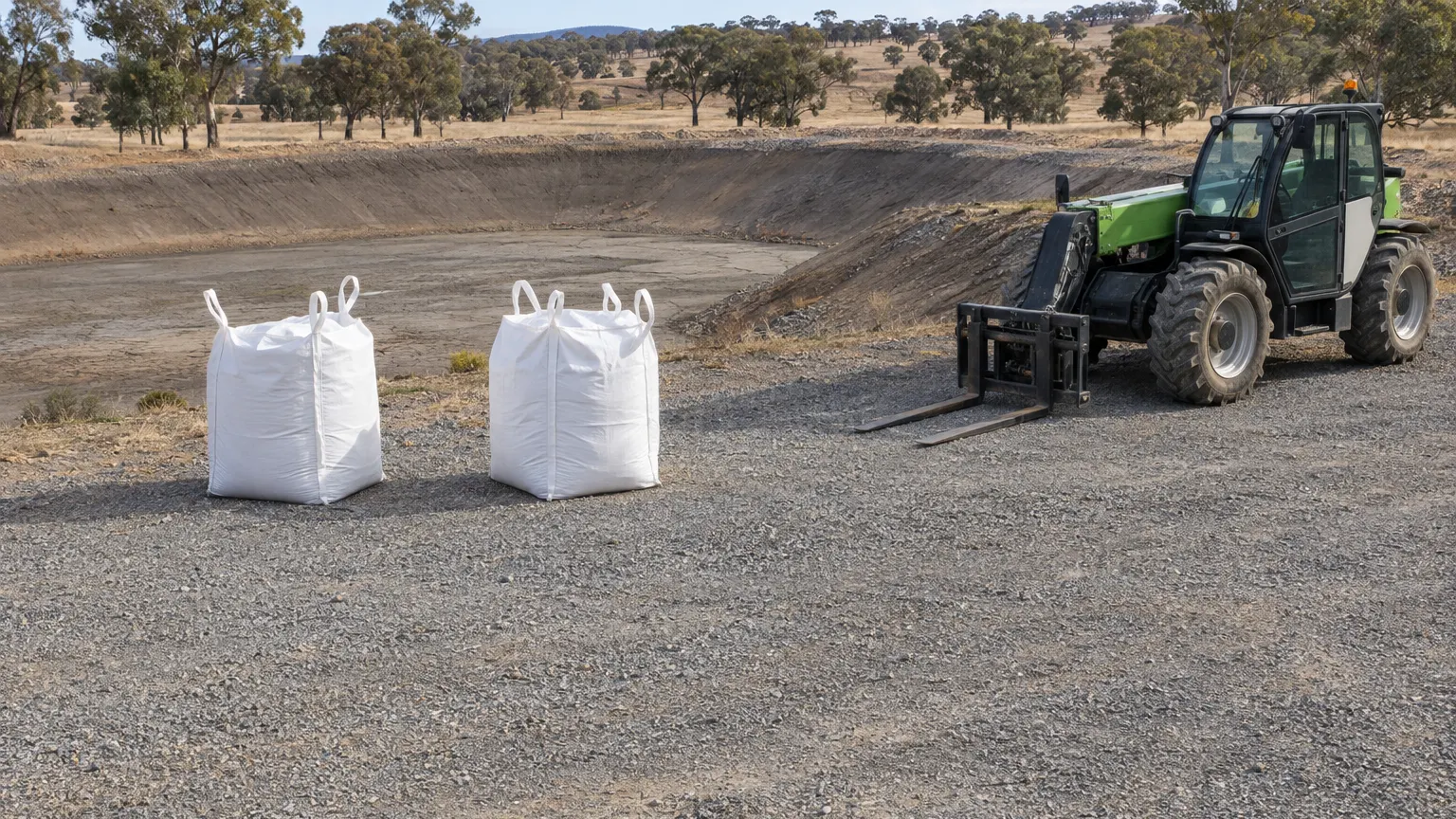
    Agree on suitable unloading equipment with the supplier, carrier and person responsible for unloading before dispatch. A 1,200 kg bag is a substantial load, and equipment suitability cannot be established from a machine’s name alone. Do not assume the delivery vehicle includes unloading equipment or that an available farm machine is suitable. Confirm the actual load, handling arrangement, equipment capacity for the intended task and operator requirements.

    SafeWork NSW’s freight loading and unloading guidance calls for planning with the people undertaking the task, appropriate plant and a suitable unloading surface. It also addresses vehicle movement, exclusion zones, driver safety zones and agreed communication.

    An exclusion zone is an area kept clear of people who are not required for the unloading operation. Establish it before work starts, agree where the driver will wait and keep people away from moving plant and pinch points. The operator needs an agreed way to communicate with the driver and others involved. Do not improvise a lifting arrangement when the truck arrives.

    What access information should you give the carrier?

    Give the carrier enough information to assess the route into the property and the unloading location. SafeWork NSW identifies vehicle restrictions, site layout, delivery times, parking, available equipment, reporting arrangements and site contacts as information drivers need before arrival. Describe gates, tight turns, overhead restrictions and any uncertain ground conditions rather than assuming a rural address establishes access. Ask the carrier to confirm what is acceptable for the actual vehicle.

    Nominate a responsible person who can be contacted during delivery. If rain changes the access track or unloading surface, tell the supplier and carrier before the vehicle arrives. Confirm where the bags will be placed and how they will subsequently be moved to the treatment area. Do not direct a heavy delivery vehicle towards a dam edge simply because it is closer to the work.

    Installation readiness before dispatch

    What site work should be arranged before the bags arrive?

    Arrange the preparation, application and compaction resources required by the chosen method, rather than treating unloading as the start of an unplanned repair. Bentonite Pro’s How It Works guidance distinguishes drained-dam methods. A mixed blanket is a treatment in which bentonite is incorporated into the prepared surface soil. A pure blanket is a separate bentonite layer placed over the prepared base and protected with a soil cover.

    For a suitable light or loam soil, the mixed-blanket sequence is preparation, distribution, mixing into the upper 150 to 200 mm and roller compaction. For suitable heavier soils, the pure-blanket sequence is preparation, distribution without mixing into the base, protective soil cover and then roller compaction. These method details come from the NSW DPI guide cited above; they do not establish Bentonite Pro’s company application rate.

    A pure blanket requires at least 100 mm of protective site soil before roller compaction, increased to at least 450 mm where stock have access. The cover comes before the roller, not after it.

    Confirm the source of suitable cover soil, access for the required machinery and a plan for protecting the treatment from disturbance and erosion. Refill gently to avoid damaging the treated surface, then monitor performance. If the work must be staged, have a site-specific plan that maintains continuous treatment; disconnected patches or successive layers should not be assumed to form a seal.

    Frequently asked questions

    Can I order from the dam’s water capacity?

    No. Bentonite Pro’s preliminary calculation uses the surface area to be treated, including the floor and relevant sloping walls, rather than the volume of water the dam holds. Two dams with similar capacities can have different treatment areas, so measure the proposed work before calculating the quantity.

    Does ordering enough bentonite guarantee a seal?

    No. The calculated quantity does not establish soil suitability or identify the cause of leakage. Assessment, the selected method, preparation, compaction and protection of the treatment remain necessary considerations.

    Should I order before confirming unloading?

    Confirm the unloading arrangement before committing to dispatch. Identify who supplies the suitable equipment, who operates it and where the work will take place. Resolve any gap with the supplier and carrier instead of assuming the driver can unload the bags.

    Buying bentonite for an assessed farm dam repair? Contact Bentonite Pro to confirm quantities and delivery requirements before ordering.

  • Bentonite Soil Suitability: Sand, Loam and Clay

    Bentonite Soil Suitability: Sand, Loam and Clay

    Short answer: Bentonite soil suitability requires checking the soil profile, leakage cause and installation method, not just whether the ground looks sandy or clayey. Bentonite Pro’s recommended application rate is 30 kg/m², which is also the rate it uses for preliminary order quantities. That rate does not establish site suitability or guarantee a seal; assess the dam before ordering.

    A soil label is a starting point for an assessment, not a treatment specification. We recommend checking what lies beneath the dam floor, whether the wall is sound and how a continuous treated layer could be installed before committing to material or machinery.

    Soil texture is the relative balance of sand, silt and clay particles in a soil. Permeability is the ease with which water passes through the material; particle packing and clay behaviour both influence it, as explained in Agriculture Victoria’s soil-materials guide.

    Bentonite soil suitability starts below the surface

    Different materials can occur at different depths and across the same dam site. Agriculture Victoria recommends assessing the range, quality and quantity of the available materials through test digging, rather than judging the site from surface appearance alone (soil assessment guidance).

    For an existing dam, we recommend asking an experienced assessor where and how samples should be obtained safely. Do not excavate a water-loaded wall or enter unstable ground to collect a sample; an investigation plan should account for stored water, machinery access and the condition of the structure.

    A useful assessment should distinguish material that allows seepage from a defect that needs a different repair. NSW DPI identifies unsuitable soils, exposed rock or sand, poor compaction and leakage beneath an embankment among the problems that can cause water loss (Leaking farm dams).

    Can bentonite seal sandy soil?

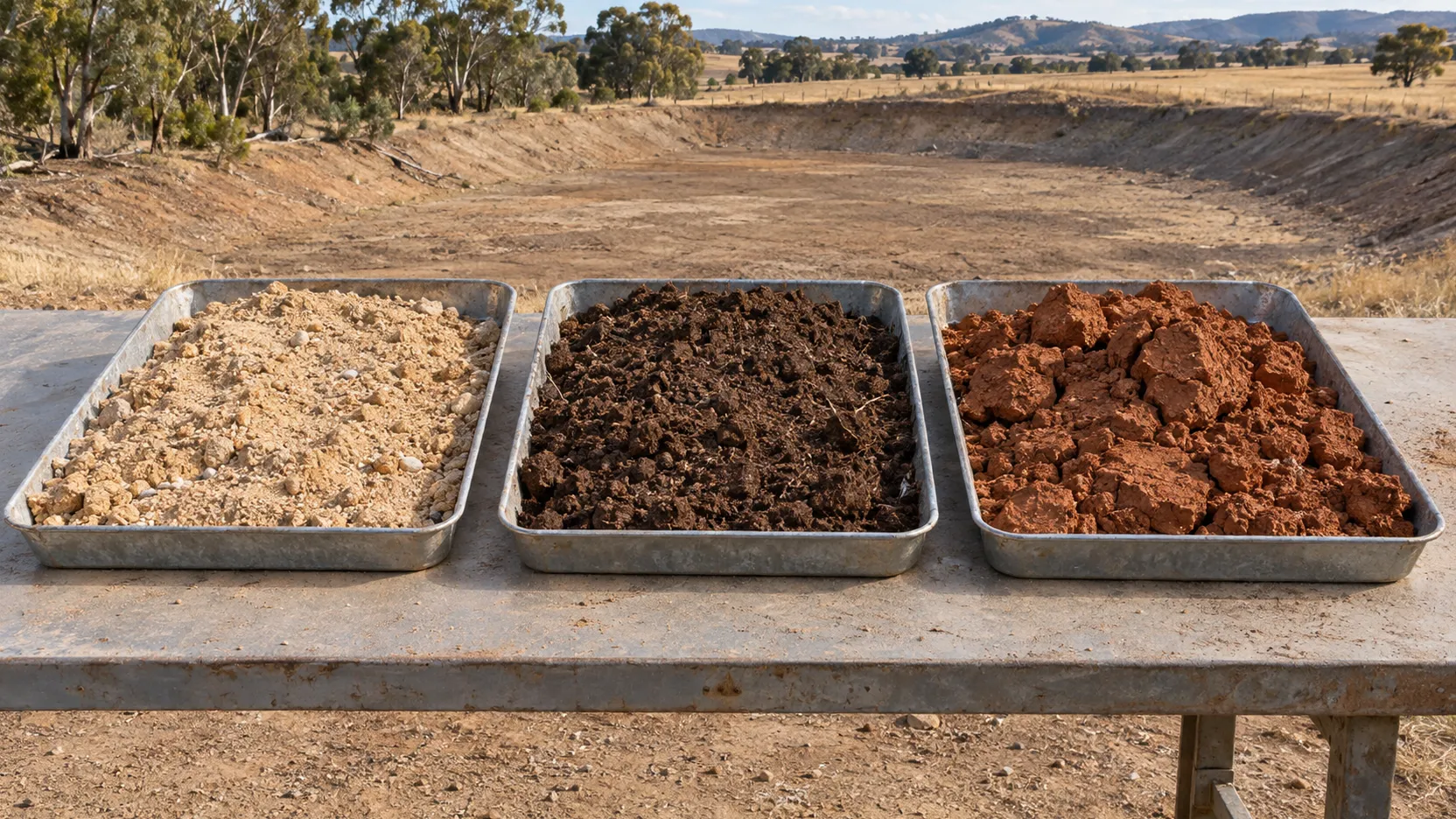
    Bentonite can be considered for suitable porous soils, but a sandy appearance is not enough to approve a treatment. Agriculture Victoria notes that bentonite may help seal pervious material, while NSW DPI describes mixed blankets for light or loam soils (soil guidance; blanket methods). We recommend checking the extent of sandy layers, whether gravel or rock interrupts the treatment area, and whether preparation and compaction are practical before treating that description as a buying decision.

    Ask whether the assessor has examined the floor and relevant sloping walls, rather than only one convenient sample near the edge. We also recommend recording any change in material exposed during earlier cleaning or excavation, without assuming that this history proves where the leak is.

    What should you check in loam soil?

    Loam soil dam sealing needs a check of the actual material and proposed mixing method, not an assumption that every loam behaves alike. NSW DPI places suitable light and loam soils in its mixed-blanket guidance, which incorporates bentonite into the prepared soil before roller compaction (mixed-blanket guidance). We recommend asking how the operator will achieve even incorporation across the full treatment area, including changes in slope, and how the completed surface will be protected during refilling.

    Does clay soil always hold water?

    Clay soil does not automatically make a watertight dam. Agriculture Victoria identifies highly dispersive clay, strongly flocculated clay and soils with marked shrinkage as potential problem materials, for different reasons (problem soil characteristics). A high clay content therefore cannot replace an assessment of behaviour. We recommend checking existing test results and construction records before selecting bentonite for clay soil, and asking whether leakage is through the material, along cracks or through another defect.

    Dispersion is the separation of clay particles in water; highly dispersive material may be prone to internal tunnelling. Flocculation is the binding together of clay particles; strongly flocculated material can retain pores that let water pass (Agriculture Victoria’s definitions and limitations).

    These are different soil behaviours, not interchangeable names for a leak. We recommend professional interpretation of unfamiliar or suspicious material rather than using a home observation to prescribe a chemical treatment or approve work on a dam wall.

    Compare the assessment questions, not invented soil-based doses

    The comparison below is a screening aid, not a design or a guarantee of suitability. Its soil concerns draw on Agriculture Victoria, while the broad mixed- and pure-blanket distinction comes from NSW DPI (soil behaviour; method guidance).

    Material encounteredWhat needs checking?What does that mean for the plan?
    Sandy or light soilExtent of porous material, underlying layers and interruptions by gravel or rock.A mixed blanket may be considered where the site and soil are suitable; do not assume adding material repairs every leakage pathway.
    Loam soilActual soil behaviour, consistent mixing and access for compaction.Assess whether a continuous mixed treatment can be installed across the proposed area.
    Heavier clay soilDispersion, shrinkage, cracks and the reason water is escaping.A pure blanket may be considered on suitable heavier soils, with protective cover before roller compaction.
    Variable, unknown or suspect groundChanges with depth, sand seams, structural condition and test results.Resolve the investigation and repair design before choosing a blanket or ordering bentonite.

    For an initial discussion, we recommend sending photographs taken from safe ground, the location, any soil reports and the history of previous work. Use the Bentonite Pro assessment enquiry to explain whether the dam can be drained and whether stock currently enter it.

    Keep the recommended rate separate from method selection

    Bentonite Pro’s recommended application rate is 30 kg/m², which is also the rate it uses for preliminary order quantities, subject to checking soil suitability, the cause of leakage and the installation method (company application guidance). This is not a rate specified by the material sheet or endorsed by NSW DPI.

    Do not turn that recommended rate into a conclusion that soil type is irrelevant. The assessment may show that a different repair is needed, or that the proposed treatment cannot be prepared, compacted and protected as required; in either case, increasing an order is not a substitute for resolving the problem.

    For preliminary quantities, use the total surface area to be treated, including the floor and relevant sloping walls, rather than water volume or the horizontal water surface alone (Bentonite Pro quantity guidance). We recommend confirming that area after the treatment plan is agreed, especially where the basin has an irregular shape.

    At the recommended 30 kg/m², 500 m² requires 15,000 kg before allowance: 500 × 30 = 15,000. Dividing by the current 1,200 kg bag gives 12.5 bags, so the minimum is 13 whole bags before allowance (company ordering calculation).

    For that same 500 m² example, a stated 5 to 10% allowance requires 14 whole bags. The allowance must be confirmed against site conditions rather than treated as a universal buffer (quantity and allowance guidance).

    Choose and protect the appropriate treatment

    A mixed blanket is a treatment in which bentonite is incorporated into the prepared soil. A pure blanket is a separate bentonite layer placed over the prepared base and protected by a soil cover; these are distinct methods in NSW DPI’s leaking-dam guidance.

    Both drained-dam methods require emptying and drying the dam, clearing loose rocks and vegetation, and assessing and preparing the site before treatment. For a mixed blanket on suitable light or loam soils, bentonite is mixed into the upper 150 to 200 mm, then compacted with a roller (NSW DPI preparation and mixing guidance).

    For a pure blanket on suitable heavier soils, spread bentonite without mixing it into the base, cover it with at least 100 mm of site soil, then compact the covered treatment with a roller. Increase protective cover to at least 450 mm where stock have access (NSW DPI cover guidance).

    Protective cover comes before roller compaction in the pure-blanket sequence. Refill gently to avoid disturbing the treated surface and monitor performance; the company method guide does not promise a fixed sealing time.

    We recommend documenting how adjoining areas will connect if the work must be staged, and how completed treatment will be protected from erosion and disturbance. Separate patches should not be assumed to form a continuous seal simply because each received the calculated quantity.

    Know what the product sheet can and cannot establish

    Sodium bentonite is a clay that swells to several times its original volume when wet, as described in the Big Ditch Bentonite specification sheet. That material property does not diagnose a leak or demonstrate that every soil will respond to the same installation method.

    The sheet lists typical montmorillonite content greater than 90% on an as-is basis. These are typical values for general information, not guaranteed specifications or a site-specific sealing guarantee (material properties and disclaimer).

    Bentonite Pro supplies high-purity sodium bentonite fines in a 1.2 tonne FIBC bulk bag at $295 + GST per tonne ($354 + GST per bag), plus road freight calculated to your address, with delivery across NSW, VIC and QLD. FIBC means flexible intermediate bulk container; the current pack contains 1,200 kg, not a separate granular-grade product.

    Frequently asked questions

    Does soil type change Bentonite Pro’s application rate?

    Our recommended application rate is 30 kg/m² for every soil type, not a sliding retail dose chart for sand, loam and clay. Soil suitability, leakage cause and the installation method must still be checked before ordering or treatment (Bentonite Pro guidance).

    Can a handful of soil prove that my dam will seal?

    No. A field observation can help an assessment, but materials vary across a site and with depth; Agriculture Victoria recommends investigation of the soil profile and laboratory examination where doubts remain (soil investigation guidance).

    Can I avoid soil preparation by adding bentonite to a full dam?

    Do not treat water-surface broadcasting as an assured repair. NSW DPI describes it as “at best hit and miss” and does not recommend it because success cannot be assured; if emptying is impractical, arrange a site assessment rather than substituting a broadcast dose for a designed treatment (broadcasting limitations).

    Unsure about bentonite soil suitability at your dam? Discuss your site with Bentonite Pro before committing to a material order or treatment method.

  • Farm Dam Leaks: Causes to Check Before Buying Bentonite

    Farm Dam Leaks: Causes to Check Before Buying Bentonite

    Short answer: Farm dam leaks can arise from unsuitable soil, poor compaction, unsealed sand or rock, and damage to the embankment, according to NSW DPI. Check evaporation and outlet losses first. Bentonite Pro recommends assessing the leakage pathway and soil before choosing a treatment or ordering material.

    For the price per tonne, coverage per bag and how freight to your address is worked out, see the sodium bentonite delivered price guide.

    A falling waterline is a reason to investigate, not a diagnosis on its own. The NSW Department of Primary Industries advises checking other losses, including evaporation and an accidentally open outlet valve, before treating a dam as leaking (Leaking Farm Dams).

    For landholders in NSW, Victoria and Queensland, the useful starting question is: where is the water going? We recommend separating water use, soil seepage and a possible embankment defect before discussing a bentonite order.

    Not sure whether bentonite suits your dam? The leaking dam triage check takes four questions and tells you whether to plan a drained treatment, get the site assessed, or have the wall checked first.

    What causes farm dam leaks?

    Seepage is water moving through soil or other material rather than leaving through the intended outlet. The distinction matters because NSW DPI identifies leakage pathways through unsuitable embankment material, beneath the wall and through exposed rock, sand or gravel in the basin (NSW DPI guidance).

    An embankment is the constructed earth bank that holds back the stored water. It needs investigation as a structure, not just as a surface that can be coated: Agriculture Victoria recommends understanding the cause of failure and available repair options before work begins (Why do dam repairs often fail?).

    Possible causeWhat to investigateWhy diagnosis comes first
    Unsuitable soil or exposed porous materialSand, gravel, rock and the soil used in the wallA surface product does not establish whether the foundation and wall are sound.
    Poor compactionConstruction history, soil moisture and how the fill was placedThe repair may require rebuilding material rather than adding a coating.
    Seepage beneath the embankmentFoundation conditions and the original cut-off trenchThe visible wet area may be separate from the entry point.
    Cracks, roots or animal damageChanges in the bank, vegetation and burrowsThe condition of the earth structure must be assessed.
    Water use or outlet lossesPumps, valves and the water-use recordThese losses must be separated from a suspected soil leak.

    The table is an inspection guide, not a way to diagnose a particular dam remotely. Its cause categories draw on NSW DPI’s leaking-dam guide and Agriculture Victoria’s maintenance guidance.

    Start with water use and a consistent record

    We recommend keeping a simple record before choosing a repair: photograph the waterline from the same safe position and note rain, pumping, stock water use and outlet-valve settings. Take another photograph after a change rather than relying on a recollection of where the water used to sit.

    Do not assign every centimetre of water loss to leakage. NSW DPI specifically identifies evaporation and open outlet valves as possible explanations for apparent leaks, while Agriculture Victoria recommends monitoring and photographing changes in water levels and visible defects (NSW DPI; Agriculture Victoria).

    We would also ask when the problem began: after construction, after a long dry period, after cleaning out the dam, or after heavy rain? Treat the answer as a lead for assessment, not proof of a particular cause.

    Unsuitable soil and poor dam compaction

    Permeability is a material’s ability to transmit water. Exposed rock, sand or gravel below the stored water level can provide a leakage pathway, and not every clay is suitable for an embankment (NSW DPI).

    Compaction is the mechanical densification of soil. The NSW guide explains that fill placed too dry or too wet can compact poorly, and that embankment material should be placed and compacted in layers rather than treated as one deep mass (soil compaction guidance).

    A firm-looking surface is not enough information for us to recommend a material order. Ask the assessor what is known about the soil below it, the construction method and whether the proposed repair needs new material, reworking or another approach.

    Agriculture Victoria recommends testing soil from the failure site, surrounding areas and potential borrow pits, which are places where repair material may be excavated (dam repair guidance). That is a better basis for selecting a treatment than assuming that any clay-coloured soil will hold water.

    Seepage beneath the wall, cracks and root damage

    A cut-off trench is an excavated and compacted barrier beneath an embankment intended to reduce water escaping through the foundation. Failure to provide an effective cut-off is one of the construction problems identified by NSW DPI.

    Roots can disturb compacted soil and provide seepage paths, while cracks may indicate settlement or possible slumping rather than a harmless surface blemish (NSW DPI; Agriculture Victoria). Do not turn that observation into a do-it-yourself instruction to pull out a mature tree or excavate a loaded dam wall.

    Wet spots at the wall or its toe, the base of the embankment, indicate water movement through the bank according to Agriculture Victoria. Record their position and whether they change, then obtain advice on the cause and significance.

    Tunnelling is the development of internal passages as soil is removed along a water pathway. Agriculture Victoria says tunnels indicate poor bank integrity and warrant professional advice (dam maintenance guidance).

    If you see growing cracks, slumping, a tunnel or an obvious change in seepage, keep people and machinery away from suspect ground and seek qualified help. This guide does not authorise excavation, tree removal or rapid drawdown as an emergency repair.

    Where does bentonite dam repair fit?

    Sodium bentonite is a clay that swells to several times its original volume when wet, as described in the Big Ditch Bentonite specification sheet. That property is not a diagnosis of your dam and does not establish that a bentonite treatment will correct a structural defect.

    Bentonite Pro uses 30 kg/m² as its recommended application rate and for preliminary order quantities, subject to assessment of soil suitability, the leakage cause and installation method (Bentonite Pro method guidance). This is not a rate specified by the material sheet or an endorsement by NSW DPI.

    The current retail pack contains 1,200 kg of sodium bentonite fines in a 1.2 tonne FIBC bulk bag, where FIBC means flexible intermediate bulk container (1.2 tonne bentonite bulk bag). Use the mass of material required, not the dam’s water volume, when calculating an order for the treated surface.

    At the recommended rate, 500 m² of treated floor and sloping-wall area requires 15,000 kg before an allowance: 500 × 30 = 15,000 (company quantity guidance). Dividing by 1,200 kg gives 12.5 bags, which rounds up to 13 whole bags before an allowance.

    One 1.2 tonne bag provides material for 40 m² at that rate before any allowance, calculated as 1,200 ÷ 30 (company quantity guidance). Calculated coverage is not a guarantee of sealing, and a rough water-surface measurement should not replace measurement of the area to be treated.

    These drained-dam methods require emptying and drying the dam, clearing loose rocks and vegetation, and preparing the treatment surface after assessment (Bentonite Pro preparation guidance). Do not interpret the short method comparison below as a substitute for the site-specific work plan.

    For suitable light or loam soils, the mixed-blanket method incorporates bentonite into the upper 150 to 200 mm of prepared soil before roller compaction; a pure blanket on suitable heavier soils is instead covered with at least 100 mm of site soil before the covered treatment is compacted (NSW DPI method guidance). The same guide increases pure-blanket protective cover to at least 450 mm where stock have access (protective-cover guidance).

    These are distinct methods, not interchangeable steps. Review the full preparation and installation guidance with the person assessing the dam before selecting one, and keep our recommended rate separate from the government’s generic method advice.

    What should you send for an initial assessment?

    We recommend collecting the following without entering deep mud, unstable banks or the water. A useful enquiry gives the assessor a record of the problem rather than asking them to infer the cause from one distant photograph.

    1. Photograph the basin, wall, spillway and any wet area from safe ground.
    2. Record when the loss started and what changed before it.
    3. Note pumping, outlets, rainfall and the observed water-level change.
    4. Describe known soil conditions, previous work and any available construction records.
    5. Explain whether draining is practical and how stock and machinery access are managed.

    You can send those details through the Bentonite Pro contact page. Ask for the assessment and access requirements to be clarified before treating a quantity estimate as a repair specification.

    Frequently asked questions

    How do you stop a dam from leaking?

    Identify the loss mechanism before selecting a repair. NSW DPI lists clay lining, bentonite and commercial liners among the available sealing approaches, but suitability depends on the problem; Agriculture Victoria advises understanding the failure cause before carrying out repairs (NSW DPI; Agriculture Victoria).

    How to fix a leaky farm pond?

    Begin with an assessment rather than a product dose. If the pond cannot be emptied, do not assume broadcasting bentonite over the water is an assured repair: NSW DPI does not recommend that technique because success cannot be assured (broadcasting limitations).

    How to control seepage in earthen dam?

    The relevant measures depend on the leakage pathway: suitable compacted soil, a functioning cut-off and treatment of exposed porous material are among the measures described by NSW DPI. A wet spot alone is not enough to select the design, so obtain a site-specific assessment before opening the bank or covering the basin.

    Investigating farm dam leaks before committing to treatment? Contact Bentonite Pro to discuss the site information needed before ordering.

  • How to Apply Bentonite to Reseal a Leaking Dam

    How to Apply Bentonite to Reseal a Leaking Dam

    Quick answer: Assess the soil and cause of leakage before treatment. For a suitable drained-dam treatment, use Bentonite Pro’s recommended 30 kg/m² rate. A mixed blanket is incorporated into soil before roller compaction; a pure blanket is covered with protective site soil before roller compaction. Refill gently.

    Before you start: preparing the dam

    This guide covers drained-dam mixed and pure blanket methods. Empty and dry the dam, then clear loose rocks, sticks and vegetation, including roots. Diagnose the leak and confirm the treatment method before work begins; a material application rate is not a substitute for that assessment.

    The NSW Department of Primary Industries guide, Leaking farm dams, describes generic mixed and pure blanket methods. It is the source for the mixing-depth and cover guidance below, not for Bentonite Pro’s recommended 30 kg/m² rate.

    Which bentonite method suits your dam: mixed or pure blanket?

    Bentonite Pro’s recommended application rate is 30 kg/m². Confirm soil suitability, the cause of leakage and the installation method before ordering or starting work. This recommended rate is not a rate specified in the product sheet or a universal guarantee of sealing. For a mixed blanket on suitable light or loam soils, incorporate bentonite into the upper 150 to 200 mm of soil, then compact with a roller. For a pure blanket on suitable heavier soils, spread bentonite over the prepared surface, cover with at least 100 mm of site soil, then compact the covered treatment with a roller. Increase the cover to at least 450 mm where stock have access.

    Step-by-step: applying the bentonite blanket

    1. Confirm that bentonite and the selected method suit the soil and cause of leakage.
    2. Empty and dry the dam, then clear the treatment area of loose rocks, sticks and vegetation, including roots.
    3. Measure the total floor and wall area to be treated. Calculate material at Bentonite Pro’s standard 30 kg/m², allow for site conditions and round up to whole 1.2 tonne bags.
    4. For a mixed blanket, prepare and harrow the soil, distribute the bentonite evenly, mix it into the upper 150 to 200 mm and then compact with a roller.
    5. For a pure blanket, distribute bentonite evenly over the prepared surface without mixing into the base. Add at least 100 mm of protective site soil, or at least 450 mm where stock have access, before compacting the covered treatment with a roller.
    6. Refill gently to avoid eroding or disturbing the treated surface, and monitor water loss after treatment.

    Why does bentonite need a soil cover layer?

    Bentonite swells to several times its original volume when wet. Protective soil cover over a pure blanket helps prevent drying, erosion and physical disturbance. Apply that cover before roller compaction, with additional protection where stock have access.

    How long does it take for a bentonite seal to start working?

    Bentonite must hydrate after water reaches the treatment. The product sheet does not establish a fixed sealing time for a particular dam. Refill gently and monitor performance; continuing water loss may require reassessment of the leak and installation.

    MethodBest forApplication rateCover layer
    Mixed blanketLight or loam soilsRecommended 30 kg/m² rate; mix into upper 150 to 200 mmMixed layer compacted with a roller; assess surface protection
    Pure blanketHeavy soils, clay-lining styleRecommended 30 kg/m² rate; spread without mixingAt least 100 mm, or 450 mm where stock have access; cover before compaction

    Can you seal a dam without emptying it first?

    Do not rely on adding bentonite to a full dam as an assured repair. The NSW DPI guide describes broadcasting over water as “at best hit and miss” and does not recommend it because success cannot be assured. Arrange a site assessment if the dam cannot be emptied. Slurry application and soil incorporation are not interchangeable techniques.

    Getting the right bentonite for the job

    Bentonite Pro supplies sodium bentonite fines in 1.2 tonne bulk bags, delivered across NSW, VIC and QLD. See the product specification sheet for typical material properties and How It Works for treatment guidance.

    Do you need special equipment to reseal a dam with bentonite?

    A roller or similar compaction equipment is essential for bedding the bentonite in properly. Hand tamping rarely achieves consistent enough compaction over a full dam floor. Beyond that, a harrow for mixed blankets and standard earthmoving equipment for clearing and cover soil are usually enough for a typical farm dam job.

    Planning a dam resealing job? Get in touch with Bentonite Pro.

    For the price per tonne, coverage per bag and how freight to your address is worked out, see the sodium bentonite delivered price guide.

  • Sodium vs Calcium Bentonite for Dam Sealing

    Sodium vs Calcium Bentonite for Dam Sealing

    Quick answer: Use sodium bentonite, not calcium bentonite, to seal a dam. Sodium bentonite swells to many times its dry volume when wet and can reduce seepage in suitable, properly installed soil treatments; calcium bentonite swells very little. Bentonite Pro supplies fines in 1.2 tonne bulk bags and uses a recommended 30 kg/m² rate, subject to site assessment.

    Sodium vs calcium bentonite: which one seals a dam?

    Bentonite is named for the dominant exchangeable cation in its clay. Sodium bentonite has a high swelling capacity in water, while calcium bentonite has negligible swelling capacity, and only sodium bentonite should be used for pond or reservoir sealing, according to University of Missouri Extension. Alabama Cooperative Extension and the US Southern Regional Aquaculture Center’s Renovating Leaky Ponds fact sheet give the same advice.

    Sodium bentoniteCalcium bentonite
    Swelling in fresh waterHigh, many times its dry volumeLow to negligible
    How it reduces seepageSwells into soil pores to form a low permeability layerFine particles, but little swelling to close pores
    Dam and pond sealingRecommended by extension guidanceNot recommended
    Soda ash “activated” versionsNot applicableLab tests found lower water holding and higher permeability than natural sodium bentonite
    Common other usesDrilling fluids, clay liners, cut off wallsAbsorbents, foundry binders, clarifying

    The activated calcium finding and the effect of water quality come from research published in Engineering Geology, which also reported that bentonite not prehydrated with fresh water swells very little or not at all in contaminated water. That is one reason to check salinity and the cause of the leak before choosing any treatment; the leaking dam repair quiz walks through those checks.

    Bentonite Pro supplies natural sodium bentonite fines. Ask any supplier for a specification sheet before you buy, and compare montmorillonite content, cation exchange capacity and swell index rather than relying on the word “bentonite” alone.

    Why sodium bentonite for dam sealing?

    Sodium bentonite is a swelling clay. When hydrated, it expands to several times its original volume and can reduce the permeability of suitable treated soils.

    Bentonite can be used in suitable dam and pond treatments. It is not a universal substitute for repairing structural faults or for other lining systems; diagnose the cause of water loss first.

    How does sodium bentonite actually seal a dam?

    Hydrated bentonite occupies pore spaces within a properly prepared treatment, helping reduce seepage. Performance depends on soil and water conditions, installation and protection of the treated layer.

    What application rate should I use?

    Bentonite Pro’s recommended application rate is 30 kg/m². Confirm soil suitability, the cause of leakage and the installation method before ordering or starting work. This recommended rate is not a rate specified in the product sheet or a universal guarantee of sealing. Our product is fines, not the separate granular grade. See How It Works for mixed and pure blanket methods and their different compaction sequences.

    What makes a high-grade sodium bentonite?

    The product specification sheet gives typical montmorillonite content above 90%, cation exchange capacity above 90 meq/100 g and a swell index of 7 to 16 mL/2 g on an as-is basis. Our fines are nominally below 1.25 mm. The swell index is not a dry-volume expansion ratio, and purity alone does not establish whether a treatment suits a particular dam.

    How much bentonite will I need?

    Surface areaBentonite needed (at 30 kg/m²)
    200 m²6,000 kg (6 tonnes)
    500 m²15,000 kg (15 tonnes)
    1,000 m²30,000 kg (30 tonnes)

    Measure the total surface area you’re sealing (floor plus walls), multiply by 30 kg/m², and add a 5 to 10% preliminary allowance, subject to confirming site conditions and the treated area.

    Choosing the right amount for your job

    Bentonite Pro supplies sodium bentonite fines in 1.2 tonne bulk bags, delivered across NSW, VIC and QLD. See How It Works for installation guidance and limitations.

    Can bentonite be applied in stages?

    Stage the work only under a site-specific plan that maintains a continuous treated layer and protects completed areas from erosion and disturbance. Compact each section as required by the chosen method; do not assume that separate, unconnected patches will seal the whole dam.

    Does the application rate change for ornamental or garden ponds?

    Bentonite Pro uses the same recommended 30 kg/m² rate for preliminary pond quantities, subject to checking site suitability and the treatment method. The current product is supplied in 1.2 tonne bulk bags; contact us to discuss whether that pack size suits your job.

    How long does a correctly applied bentonite seal last?

    Service life depends on soil and water conditions, installation quality and protection from erosion, roots, burrowing animals, stock traffic and drying. A correctly selected and installed treatment can provide ongoing seepage control, but the product specification does not establish a guaranteed service life.

    Not sure which quantity suits your dam or pond? Get in touch with Bentonite Pro.

    For the price per tonne, coverage per bag and how freight to your address is worked out, see the sodium bentonite delivered price guide.

  • Bentonite Application Rate for Sealing a Dam or Pond

    Bentonite Application Rate for Sealing a Dam or Pond

    Quick answer: Use Bentonite Pro’s recommended 30 kg/m² rate to calculate your order, then round up to whole 1.2 tonne bags. Confirm soil suitability, the cause of leakage and the treatment method before proceeding.

    How much bentonite do you actually need?

    For preliminary ordering, multiply the total area to be treated by Bentonite Pro’s recommended application rate of 30 kg/m². Include the dam floor and any walls to be treated; quantity alone does not establish whether bentonite is suitable for the leak.

    Does soil type change the application rate?

    Bentonite Pro’s recommended application rate is 30 kg/m². Confirm soil suitability, the cause of leakage and the installation method before ordering or starting work. This recommended rate is not a rate specified in the product sheet or a universal guarantee of sealing.

    How do you calculate the total bentonite needed for a project?

    1. Measure the surface area to be sealed: length × width for the base, plus batter (sloped wall) area if you’re sealing the sides too.
    2. Multiply the total square metres by Bentonite Pro’s recommended application rate of 30 kg/m².
    3. Add a 5 to 10% preliminary allowance, subject to confirming site conditions and the treated area.

    Sodium bentonite is a swelling clay that expands to several times its original volume when wet. The product sheet records a typical swell index of 7 to 16 mL/2 g, which is not a dry-volume expansion ratio.

    How much bentonite for common dam and pond sizes

    Surface areaBentonite needed (at 30 kg/m²)
    200 m²6,000 kg (6 tonnes)
    500 m²15,000 kg (15 tonnes)
    1,000 m²30,000 kg (30 tonnes)

    Allow for measured site conditions and round the calculated requirement up to whole 1.2 tonne bags. Confirm the quantity before dispatch rather than relying on a universal buffer.

    Buying the right amount for your project

    Bentonite Pro supplies sodium bentonite fines in 1.2 tonne bulk bags, delivered across NSW, VIC and QLD.

    For 500 m² at 30 kg/m², you need 15,000 kg. This is 12.5 bags of 1,200 kg, so order at least 13 whole bags before an allowance. Including a 5 to 10% allowance requires 14 whole bags. Confirm the treated area and allowance before ordering.

    What happens if you under-apply bentonite?

    An uneven or insufficient treatment may leave seepage paths. Using enough material is only one requirement: soil suitability, continuity of the treated layer, cover and compaction also need to be checked.

    Can you apply bentonite in stages?

    Stage the work only under a site-specific plan that maintains a continuous treated layer and protects completed areas from erosion and disturbance. Compact each section as required by the chosen method; do not assume that separate, unconnected patches will seal the whole dam.

    Does bentonite application rate change for ornamental or garden ponds?

    Bentonite Pro uses the same recommended 30 kg/m² rate for preliminary pond quantities, subject to checking site suitability and the treatment method. The current product is supplied in 1.2 tonne bulk bags; contact us to discuss whether that pack size suits your job.

    How long does a correctly applied bentonite seal last?

    Service life depends on soil and water conditions, installation quality and protection from erosion, roots, burrowing animals, stock traffic and drying. A correctly selected and installed treatment can provide ongoing seepage control, but the product specification does not establish a guaranteed service life.

    Need help sizing your bentonite order? Get in touch with Bentonite Pro.

    For the price per tonne, coverage per bag and how freight to your address is worked out, see the sodium bentonite delivered price guide.