
Bentonite Guides
How to Apply Bentonite to Reseal a Leaking Dam
Sep
Quick answer: Assess the soil and cause of leakage before treatment. For a suitable drained-dam treatment, use Bentonite Pro’s 30 kg/m² standard. A mixed blanket is incorporated into soil before roller compaction; a pure blanket is covered with protective site soil before roller compaction. Refill gently.
Before you start: preparing the dam
This guide covers drained-dam mixed and pure blanket methods. Empty and dry the dam, then clear loose rocks, sticks and vegetation, including roots. Diagnose the leak and confirm the treatment method before work begins; a material application rate is not a substitute for that assessment.
The NSW Department of Primary Industries guide, Leaking farm dams, describes generic mixed and pure blanket methods. It is the source for the mixing-depth and cover guidance below, not for Bentonite Pro’s 30 kg/m² company standard.
Which bentonite method suits your dam: mixed or pure blanket?
Bentonite Pro’s standard application rate is 30 kg/m². Confirm soil suitability, the cause of leakage and the installation method before ordering or starting work. This company standard is not a rate specified in the product sheet or a universal guarantee of sealing. For a mixed blanket on suitable light or loam soils, incorporate bentonite into the upper 150 to 200 mm of soil, then compact with a roller. For a pure blanket on suitable heavier soils, spread bentonite over the prepared surface, cover with at least 100 mm of site soil, then compact the covered treatment with a roller. Increase the cover to at least 450 mm where stock have access.
Step-by-step: applying the bentonite blanket
- Confirm that bentonite and the selected method suit the soil and cause of leakage.
- Empty and dry the dam, then clear the treatment area of loose rocks, sticks and vegetation, including roots.
- Measure the total floor and wall area to be treated. Calculate material at Bentonite Pro’s standard 30 kg/m², allow for site conditions and round up to whole 1.2 tonne bags.
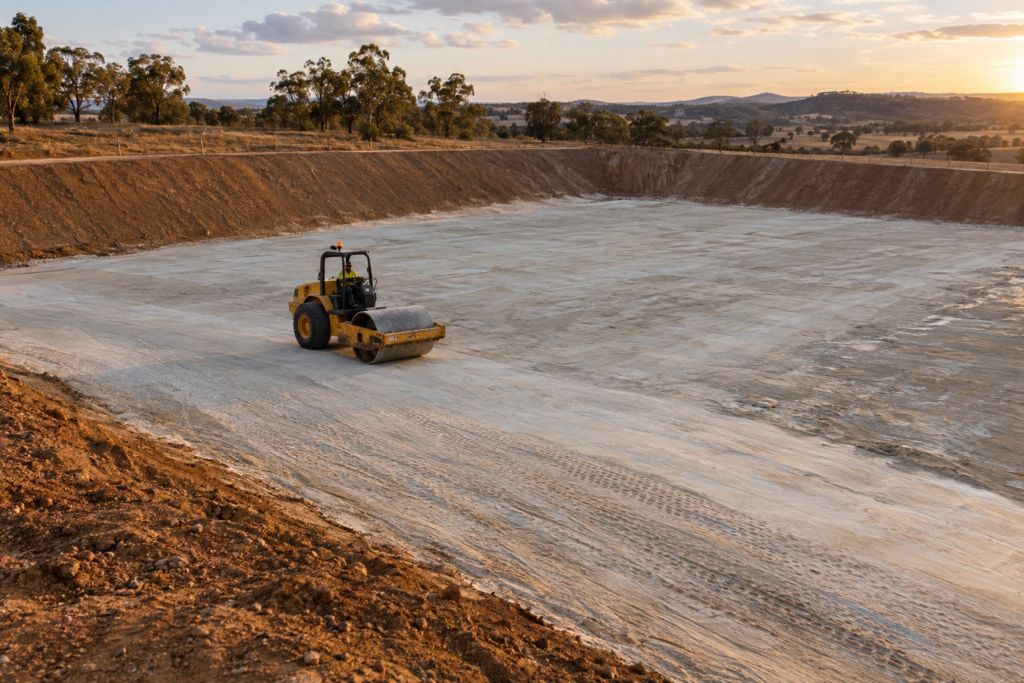
- For a mixed blanket, prepare and harrow the soil, distribute the bentonite evenly, mix it into the upper 150 to 200 mm and then compact with a roller.
- For a pure blanket, distribute bentonite evenly over the prepared surface without mixing into the base. Add at least 100 mm of protective site soil, or at least 450 mm where stock have access, before compacting the covered treatment with a roller.
- Refill gently to avoid eroding or disturbing the treated surface, and monitor water loss after treatment.
Why does bentonite need a soil cover layer?
Bentonite swells to several times its original volume when wet. Protective soil cover over a pure blanket helps prevent drying, erosion and physical disturbance. Apply that cover before roller compaction, with additional protection where stock have access.
How long does it take for a bentonite seal to start working?
Bentonite must hydrate after water reaches the treatment. The product sheet does not establish a fixed sealing time for a particular dam. Refill gently and monitor performance; continuing water loss may require reassessment of the leak and installation.
| Method | Best for | Application rate | Cover layer |
|---|---|---|---|
| Mixed blanket | Light or loam soils | 30 kg/m² company standard; mix into upper 150 to 200 mm | Mixed layer compacted with a roller; assess surface protection |
| Pure blanket | Heavy soils, clay-lining style | 30 kg/m² company standard; spread without mixing | At least 100 mm, or 450 mm where stock have access; cover before compaction |
Can you seal a dam without emptying it first?
Do not rely on adding bentonite to a full dam as an assured repair. The NSW DPI guide describes broadcasting over water as “at best hit and miss” and does not recommend it because success cannot be assured. Arrange a site assessment if the dam cannot be emptied. Slurry application and soil incorporation are not interchangeable techniques.
Getting the right bentonite for the job
Bentonite Pro supplies sodium bentonite fines in 1.2 tonne bulk bags, delivered across NSW, VIC and QLD. See the product specification sheet for typical material properties and How It Works for treatment guidance.
Do you need special equipment to reseal a dam with bentonite?
A roller or similar compaction equipment is essential for bedding the bentonite in properly. Hand tamping rarely achieves consistent enough compaction over a full dam floor. Beyond that, a harrow for mixed blankets and standard earthmoving equipment for clearing and cover soil are usually enough for a typical farm dam job.
Planning a dam resealing job? Get in touch with Bentonite Pro.
For bulk bag prices, coverage per bag and indicative delivered costs to regional towns, see the sodium bentonite delivered price guide.
