
Bentonite Guides
Bentonite Application Rate for Sealing a Dam or Pond
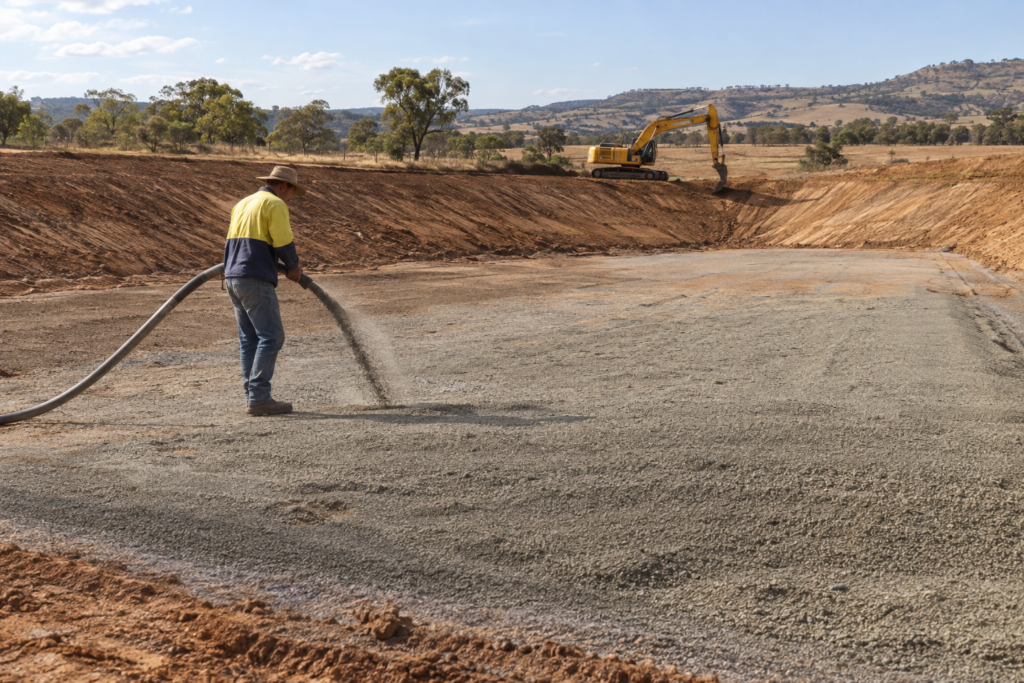
Sep
Quick answer: Bentonite application rates for sealing a dam or pond typically range from 5-10 kg/m² on clay-rich soils up to 20-30 kg/m² on sandy or poorly-graded ground. Measure the surface area, factor in your soil type, and add a margin for uneven ground before ordering.
How much bentonite do you actually need?
The right application rate depends on what’s already in your soil. A dam base with good clay content holds bentonite in place at a lower rate, while sandy or gravelly ground needs a heavier application to close up the gaps between particles.
A typical clayey sand base takes around 8 kg of sodium bentonite per square metre to form an effective seal, while a poorly graded sand with very little natural clay content can require 18-30 kg/m² to stop percolation entirely.
Does soil type change the application rate?
Yes. Soil type is the single biggest factor in how much bentonite a dam or pond needs. Clay-heavy soils already have some natural sealing capacity, so bentonite tops up what’s there. Sandy soils have almost none, so the bentonite has to do all the work of filling the pore space between grains.
How do you calculate the total bentonite needed for a project?
- Measure the surface area to be sealed — length × width for the base, plus batter (sloped wall) area if you’re sealing the sides too.
- Identify your soil type by digging a test pit or getting a simple soil assessment done.
- Multiply the total square metres by your application rate (kg/m²) for that soil type.
- Add 5-10% extra to cover uneven ground, low spots, and edges where a heavier hand is worthwhile.
Sodium bentonite is a swelling clay that expands to 10-15 times its dry volume when hydrated, forming a low-permeability barrier that stops water percolating through soil.
Bentonite application rates by soil type
| Soil type | Application rate (kg/m²) | Notes |
|---|---|---|
| Clayey sand | 8 kg/m² | Good natural clay content already present |
| Well-graded sand (some clay) | 12 kg/m² | Moderate particle size variation |
| Poorly graded sand (uniform particle size) | 18-30 kg/m² | Little to no natural sealing capacity |
| General blanket application (dam floor and walls) | 5-10 kg/m² | Standard reseal on reasonable base soil |
These figures line up with published guidance from Sealing Leaking Dams and industry application-rate data from Cape Bentonite’s technical guidance. Always over-order slightly rather than run short mid-job — a second delivery mid-project costs more in time than the extra bags would have.
Buying the right amount for your project
Bentonite Pro supplies sodium bentonite for pond and dam sealing across NSW, VIC and QLD, in 25kg bags for small jobs and touch-ups, right through to 1-tonne bulk bags and full pallets for larger dams and ponds.
For a 500 m² dam floor on clayey sand at 8 kg/m², you’d need around 4 tonnes of bentonite — roughly 3-4 bulk bags, or a full pallet plus a bulk bag. If you’re unsure which soil category your site falls into, see our how it works guide for a walk-through of the sealing process, or reach out and we’ll help you size the order correctly.
What happens if you under-apply bentonite?
An under-applied bentonite layer leaves gaps that water finds over time, so the seal fails gradually rather than all at once — often showing up as a slow drop in water level over the following season rather than an obvious leak.
Can you apply bentonite in stages?
Yes, bentonite can be applied in stages if budget or delivery timing requires it, provided each stage is properly compacted before the next layer goes down. Leaving a partially sealed base exposed to heavy rain between stages can wash out the unprotected sections.
Does bentonite application rate change for ornamental or garden ponds?
Smaller ornamental ponds generally use the same per-square-metre rates as farm dams, since the physics of sealing sandy versus clay soil doesn’t change with scale — you’ll just be working with a 25kg bag rather than a bulk delivery.
How long does a correctly applied bentonite seal last?
A bentonite seal applied at the correct rate and properly compacted can last for decades, provided it isn’t disturbed by burrowing animals, root intrusion, or repeated dry-out and cracking in drought conditions.
Need help sizing your bentonite order? Get in touch with Bentonite Pro.
