
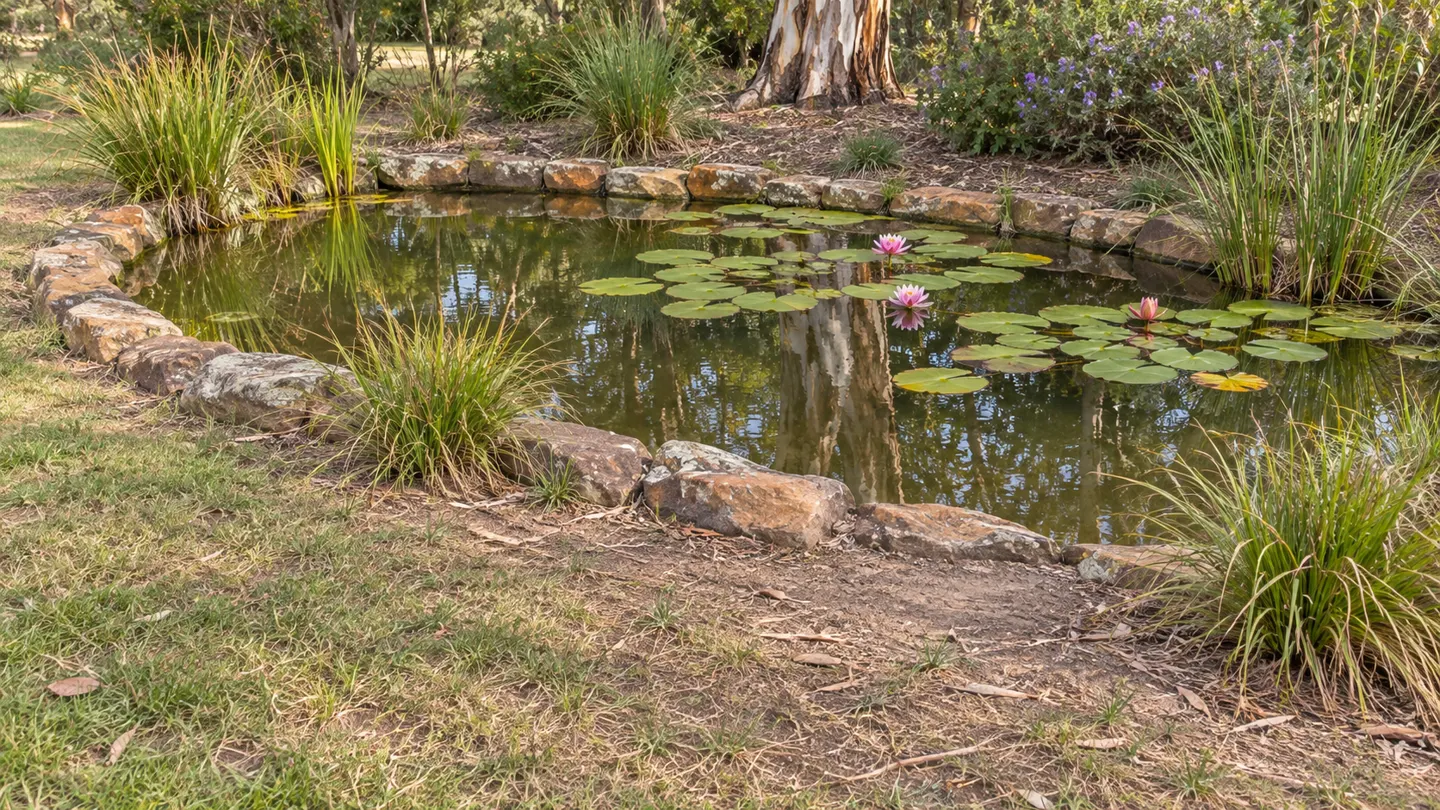
Short answer: Bentonite for garden ponds is worth considering when water is escaping through suitable soil. First establish what holds the water: earth, a flexible liner or a rigid shell. Check the plumbing and pond edges before blaming the floor. For an earthen pond, confirm that it can be drained, prepared and compacted before ordering material.
Lift the edge of a planting basket and you might see gravel, silt or soil. None of those tells you what lies underneath. A pond with a natural-looking stone edge can have a rubber liner; a concrete lip can hide an earthen basin. The useful starting point is a construction photo, an exposed edge you can inspect without disturbing it, or a call to the installer.
Bentonite for garden ponds: find the water barrier
An earthen pond holds water against soil in its floor and banks. A pond liner is a separate sheet that holds the water, even when there is soil or gravel above it. A preformed shell or a concrete basin is a third arrangement. Oklahoma State University Extension’s water garden guide distinguishes these construction types and recommends planning for drainage, pipes, filters and pumps. Those details matter as much during a repair as they do at installation.
| What holds the water? | What to check first | What to do next |
|---|---|---|
| Earth | Is the loss consistent with seepage through soil rather than a pipe or overflow? | Have the soil and access assessed for a drained treatment. |
| Flexible sheet | Is a liner edge low, a connection leaking or the sheet damaged? | Identify the liner material and seek a compatible repair. |
| Rigid shell or concrete | Are there cracks, leaking fittings or water escaping around the rim? | Have the shell or fitting assessed rather than treating the soil underneath. |
| Unknown | Are installation records or photos available? | Establish the construction before lifting stones or ordering bentonite. |
Is the pump returning water to the pond?
Follow the visible route from the pump to the point where water returns. A hose can lead behind a rockery; a waterfall can discharge partly outside the rim. Look for escaping water while the feature is running and record where you see it. A wet patch beside a return hose is a reason to inspect the hose, not proof that the whole floor leaks. Do not interrupt a system that fish depend on for aeration or filtration without a suitable care plan.
Mark the water level against a fixed point and record top-ups, rain and whether the water feature was running. The NSW DPI guide to leaking farm dams recommends ruling out other losses, including evaporation and an open outlet, before diagnosing a soil leak. Keep the observations rather than relying on a single drop in level. They help the assessor decide which part to inspect.
Can a drained treatment fit an ornamental pond?
Start with access, not the bag size. A shelf that holds a row of water lilies may leave no room for a roller. Steps or a narrow gate may prevent equipment reaching the basin at all. If fish or plants must be moved, arrange suitable temporary care and a drainage plan before work begins. An empty basin is not permission to drive machinery over buried services or a concealed liner.
Which method is the assessor proposing?
For either drained method, empty and dry the pond, clear rocks and vegetation, and assess the exposed soil. For a mixed blanket on suitable light or loam soils, distribute bentonite, mix it into the upper 150 to 200 mm of soil and then compact with a roller. That figure is a mixing depth, not the thickness of a layer of bentonite.
For a pure blanket on suitable heavier soil, distribute bentonite on the prepared surface without mixing it in. Cover it with at least 100 mm of site soil, or at least 450 mm where stock have access, then roller-compact the covered treatment. On a shallow planting shelf, mark the proposed finished level before committing: protective soil takes up space that previously held water or a plant basket. These sequences follow NSW DPI’s method guidance, also set out in Bentonite Pro’s installation guide.
Ask how the installer will treat the junction between each shelf and the sloping bank. If access prevents a continuous, protected treatment, stop and review the design rather than leaving an untreated strip. After installation, refill gently so the incoming water does not scour the surface. Monitor the level and the condition of the edges; there is no fixed day on which the pond can be declared sealed.
Measure the pond treatment area, not the litres
Water volume helps when choosing a pump; it does not tell you how much soil needs treatment. Measure the floor, any shelves to be treated and the relevant sloping walls along their surfaces. Count each surface once. If the proposed treatment stops below a shelf, have the assessor explain how the boundary will work before taking that shelf out of the calculation.
Bentonite Pro’s recommended rate is 30 kg/m². Check soil suitability, the cause of leakage and the installation method before ordering or treating. The rate comes from Bentonite Pro, not NSW DPI or the Big Ditch Bentonite specification sheet. The sheet describes the material; it does not establish whether a particular pond will seal.
How much bentonite does a small pond need?
Suppose the assessed floor measures 8 m² and the shelves and sloping walls add another 4 m². The total is 12 m², so the calculation is 12 × 30 = 360 kg before any allowance. Bentonite Pro supplies high-purity sodium bentonite fines in 1.2 tonne bulk bags. Dividing 360 kg by 1,200 kg gives 0.3 of a bag; the minimum whole-bag order is one. That leaves 840 kg beyond the calculated requirement. It is not a reason to put the entire bag into the pond.
One bag represents 40 m² of calculated coverage at the recommended rate before allowance, not a guarantee of sealing. For a small garden, the gap between treatment quantity and order quantity can be the deciding factor. Consider how a bulk bag would be delivered and unloaded before comparing material costs.
Frequently asked questions
Can I sprinkle bentonite into a full garden pond?
Do not rely on broadcasting material over water or adding slurry as a repair. NSW DPI does not recommend broadcasting because success cannot be assured. If the pond cannot be emptied, arrange a site assessment. The drained methods are not instructions for dosing a stocked pond, and a product specification is not fish-care advice.
Should I cover a torn liner with bentonite?
No. Treating permeable soil and repairing a torn sheet are different jobs. Identify the liner and ask its supplier or installer about a compatible repair before burying the damage. Photograph the defect and nearby fittings while they are visible.

Angus Hughson, CEO, Big Ditch Dam Building Company.
Considering bentonite for garden ponds? Contact Bentonite Pro with a photo of the pond edge, the basin type and your measured treatment area before ordering.