
Bentonite Guides
Buying Bentonite: A Farm Dam Order Checklist
Oct
Short answer: Buying bentonite for a farm dam starts with checking the leak, soil suitability and treatment method. Bentonite Pro uses 30 kg/m² for preliminary ordering, subject to those checks. Measure the floor and relevant sloping walls, round quantities up to whole 1.2 tonne bags, and confirm delivery access and safe unloading before ordering.
Buying bentonite: what needs to be ready?
Have a treatment plan, a measured treatment area and a workable delivery arrangement before committing to a bulk order. Bentonite Pro supplies sodium bentonite fines for assessed dam-sealing applications. Sodium bentonite is a clay material that swells to several times its original volume when wet. Buying it does not establish that it is the right repair for a particular dam.
A useful order checklist connects the proposed repair to the material quantity and the work needed on site. It should tell the supplier where the load is going and tell the person doing the work what has been allowed for. If either part is unresolved, settle it before treating a calculated quantity as a final order.
- Assess the loss of water, site soil and proposed treatment method.
- Measure the entire surface to be treated, including relevant sloping walls.
- Calculate the material mass and round up to whole bags.
- Confirm the product, delivery destination and written quote.
- Agree on truck access, suitable unloading equipment and a safe unloading area.
- Arrange site preparation, installation equipment and protection of the treated surface.
What should you check before buying bentonite?
Check why the dam is losing water and whether the proposed treatment addresses that cause. The NSW DPI guide to leaking farm dams discusses water losses, soil conditions and treatment methods. A falling water level alone does not identify a leak that bentonite can repair. Evaporation, losses through outlets and leakage need to be distinguished, and the soil and construction need assessment before a repair is chosen.
For the drained-dam methods covered here, allow for emptying and drying the dam, removing rocks and vegetation, and assessing the exposed surface before treatment. If the dam cannot be emptied, ask for a site assessment rather than ordering material for an improvised water-surface application. NSW DPI describes broadcasting as “at best hit and miss” and does not recommend it because success cannot be assured.
How many bulk bags should you order?
Calculate the mass from the total surface area to be treated, then round up to whole bags. Bentonite Pro’s application and preliminary ordering standard is 30 kg/m², subject to checking soil suitability, the cause of leakage and the installation method. This is the company standard, not a rate specified by the manufacturer’s sheet or attributed to NSW DPI. The surface area includes the floor and relevant sloping walls, not just the water surface viewed from above.
Required mass in kilograms equals treated area in square metres multiplied by 30. The minimum whole-bag quantity equals that mass divided by 1,200, rounded up.
For 500 m², the preliminary calculation is 15,000 kg, or 12.5 bags. Round that up to 13 whole bags before any additional allowance.
A stated 5 to 10% allowance on the 15,000 kg requirement results in 14 whole bags. Confirm the allowance against site conditions rather than adding an unexplained margin.
One 1.2 tonne bag provides material for a calculated 40 m² at 30 kg/m² before an allowance. Calculated coverage is not a guarantee of sealing.
Keep the measurement and calculation with the order. If the final assessed treatment extends farther up the walls or includes another area, revise the calculation before confirming the quantity. Extra material does not correct an unsuitable soil, a wrongly diagnosed leak or an installation that leaves untreated gaps.
What product details belong on the quote?
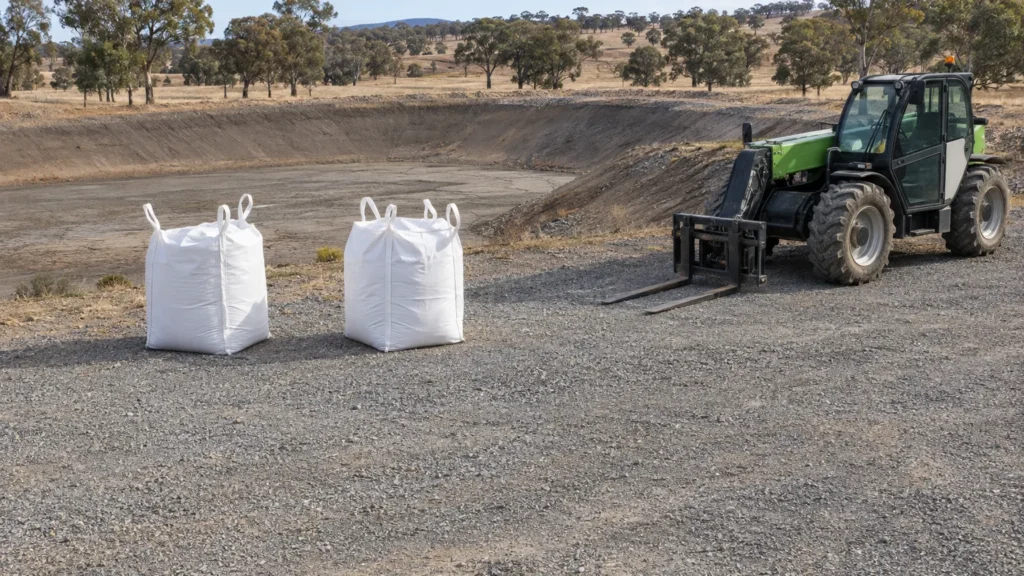
Specify the current Bentonite Pro 1.2 tonne sodium bentonite fines bulk bag, the number of bags and the delivery address. The supplied retail product is high-purity sodium bentonite fines, with 1,200 kg in each bag. FIBC means flexible intermediate bulk container, the large flexible bag used to hold the material. Pallet freight describes a delivery arrangement, not a separate bentonite product.
The Big Ditch Bentonite specification sheet lists typical montmorillonite content greater than 90% on an as-is basis. Its typical values are general information, not guaranteed specifications or evidence of suitability for every dam.
Ask for the material charge, GST, freight and any agreed unloading arrangements to be identified in the quote. Confirm the delivery address and contact details rather than relying on a town name alone. Bentonite Pro’s delivery regions are NSW, VIC and QLD; the carrier arrangement for the particular property still needs confirmation. Keep the accepted quote with the order calculation so the person receiving the load knows the agreed quantity and arrangements.
Delivery and unloading checks
What equipment is needed to unload bentonite?
Agree on suitable unloading equipment with the supplier, carrier and person responsible for unloading before dispatch. A 1,200 kg bag is a substantial load, and equipment suitability cannot be established from a machine’s name alone. Do not assume the delivery vehicle includes unloading equipment or that an available farm machine is suitable. Confirm the actual load, handling arrangement, equipment capacity for the intended task and operator requirements.
SafeWork NSW’s freight loading and unloading guidance calls for planning with the people undertaking the task, appropriate plant and a suitable unloading surface. It also addresses vehicle movement, exclusion zones, driver safety zones and agreed communication.
An exclusion zone is an area kept clear of people who are not required for the unloading operation. Establish it before work starts, agree where the driver will wait and keep people away from moving plant and pinch points. The operator needs an agreed way to communicate with the driver and others involved. Do not improvise a lifting arrangement when the truck arrives.
What access information should you give the carrier?
Give the carrier enough information to assess the route into the property and the unloading location. SafeWork NSW identifies vehicle restrictions, site layout, delivery times, parking, available equipment, reporting arrangements and site contacts as information drivers need before arrival. Describe gates, tight turns, overhead restrictions and any uncertain ground conditions rather than assuming a rural address establishes access. Ask the carrier to confirm what is acceptable for the actual vehicle.
Nominate a responsible person who can be contacted during delivery. If rain changes the access track or unloading surface, tell the supplier and carrier before the vehicle arrives. Confirm where the bags will be placed and how they will subsequently be moved to the treatment area. Do not direct a heavy delivery vehicle towards a dam edge simply because it is closer to the work.
Installation readiness before dispatch
What site work should be arranged before the bags arrive?
Arrange the preparation, application and compaction resources required by the chosen method, rather than treating unloading as the start of an unplanned repair. Bentonite Pro’s How It Works guidance distinguishes drained-dam methods. A mixed blanket is a treatment in which bentonite is incorporated into the prepared surface soil. A pure blanket is a separate bentonite layer placed over the prepared base and protected with a soil cover.
For a suitable light or loam soil, the mixed-blanket sequence is preparation, distribution, mixing into the upper 150 to 200 mm and roller compaction. For suitable heavier soils, the pure-blanket sequence is preparation, distribution without mixing into the base, protective soil cover and then roller compaction. These method details come from the NSW DPI guide cited above; they do not establish Bentonite Pro’s company application rate.
A pure blanket requires at least 100 mm of protective site soil before roller compaction, increased to at least 450 mm where stock have access. The cover comes before the roller, not after it.
Confirm the source of suitable cover soil, access for the required machinery and a plan for protecting the treatment from disturbance and erosion. Refill gently to avoid damaging the treated surface, then monitor performance. If the work must be staged, have a site-specific plan that maintains continuous treatment; disconnected patches or successive layers should not be assumed to form a seal.
Frequently asked questions
Can I order from the dam’s water capacity?
No. Bentonite Pro’s preliminary calculation uses the surface area to be treated, including the floor and relevant sloping walls, rather than the volume of water the dam holds. Two dams with similar capacities can have different treatment areas, so measure the proposed work before calculating the quantity.
Does ordering enough bentonite guarantee a seal?
No. The calculated quantity does not establish soil suitability or identify the cause of leakage. Assessment, the selected method, preparation, compaction and protection of the treatment remain necessary considerations.
Should I order before confirming unloading?
Confirm the unloading arrangement before committing to dispatch. Identify who supplies the suitable equipment, who operates it and where the work will take place. Resolve any gap with the supplier and carrier instead of assuming the driver can unload the bags.
Buying bentonite for an assessed farm dam repair? Contact Bentonite Pro to confirm quantities and delivery requirements before ordering.
