
Bentonite Guides
Bentonite Soil Suitability: Sand, Loam and Clay
Oct
Short answer: Bentonite soil suitability requires checking the soil profile, leakage cause and installation method, not just whether the ground looks sandy or clayey. Bentonite Pro’s recommended application rate is 30 kg/m², which is also its preliminary ordering standard. That rate does not establish site suitability or guarantee a seal; assess the dam before ordering.
A soil label is a starting point for an assessment, not a treatment specification. We recommend checking what lies beneath the dam floor, whether the wall is sound and how a continuous treated layer could be installed before committing to material or machinery.
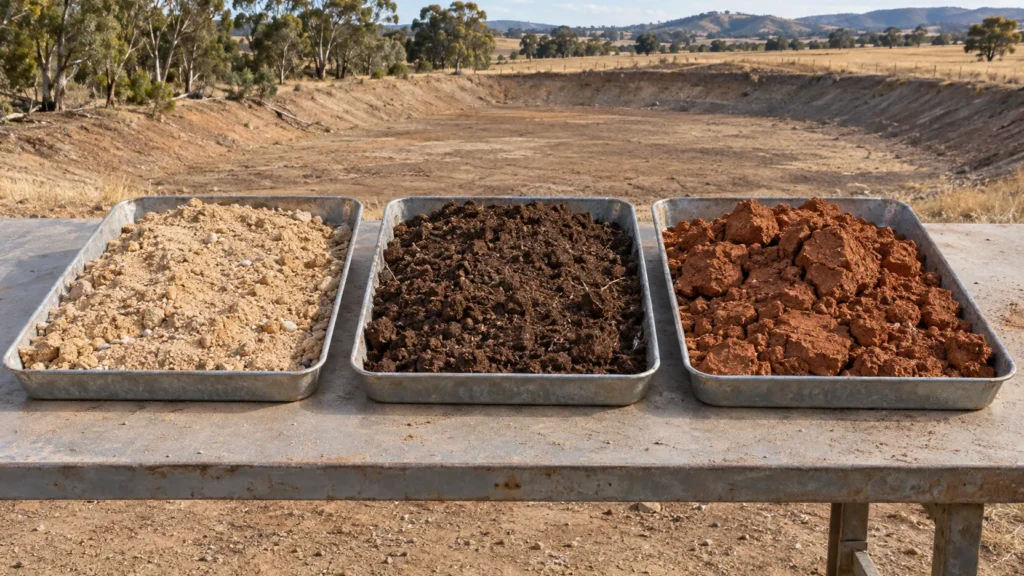
Soil texture is the relative balance of sand, silt and clay particles in a soil. Permeability is the ease with which water passes through the material; particle packing and clay behaviour both influence it, as explained in Agriculture Victoria’s soil-materials guide.
Bentonite soil suitability starts below the surface
Different materials can occur at different depths and across the same dam site. Agriculture Victoria recommends assessing the range, quality and quantity of the available materials through test digging, rather than judging the site from surface appearance alone (soil assessment guidance).
For an existing dam, we recommend asking an experienced assessor where and how samples should be obtained safely. Do not excavate a water-loaded wall or enter unstable ground to collect a sample; an investigation plan should account for stored water, machinery access and the condition of the structure.
A useful assessment should distinguish material that allows seepage from a defect that needs a different repair. NSW DPI identifies unsuitable soils, exposed rock or sand, poor compaction and leakage beneath an embankment among the problems that can cause water loss (Leaking farm dams).
Can bentonite seal sandy soil?
Bentonite can be considered for suitable porous soils, but a sandy appearance is not enough to approve a treatment. Agriculture Victoria notes that bentonite may help seal pervious material, while NSW DPI describes mixed blankets for light or loam soils (soil guidance; blanket methods). We recommend checking the extent of sandy layers, whether gravel or rock interrupts the treatment area, and whether preparation and compaction are practical before treating that description as a buying decision.
Ask whether the assessor has examined the floor and relevant sloping walls, rather than only one convenient sample near the edge. We also recommend recording any change in material exposed during earlier cleaning or excavation, without assuming that this history proves where the leak is.
What should you check in loam soil?
Loam soil dam sealing needs a check of the actual material and proposed mixing method, not an assumption that every loam behaves alike. NSW DPI places suitable light and loam soils in its mixed-blanket guidance, which incorporates bentonite into the prepared soil before roller compaction (mixed-blanket guidance). We recommend asking how the operator will achieve even incorporation across the full treatment area, including changes in slope, and how the completed surface will be protected during refilling.
Does clay soil always hold water?
Clay soil does not automatically make a watertight dam. Agriculture Victoria identifies highly dispersive clay, strongly flocculated clay and soils with marked shrinkage as potential problem materials, for different reasons (problem soil characteristics). A high clay content therefore cannot replace an assessment of behaviour. We recommend checking existing test results and construction records before selecting bentonite for clay soil, and asking whether leakage is through the material, along cracks or through another defect.
Dispersion is the separation of clay particles in water; highly dispersive material may be prone to internal tunnelling. Flocculation is the binding together of clay particles; strongly flocculated material can retain pores that let water pass (Agriculture Victoria’s definitions and limitations).
These are different soil behaviours, not interchangeable names for a leak. We recommend professional interpretation of unfamiliar or suspicious material rather than using a home observation to prescribe a chemical treatment or approve work on a dam wall.
Compare the assessment questions, not invented soil-based doses
The comparison below is a screening aid, not a design or a guarantee of suitability. Its soil concerns draw on Agriculture Victoria, while the broad mixed- and pure-blanket distinction comes from NSW DPI (soil behaviour; method guidance).
| Material encountered | What needs checking? | What does that mean for the plan? |
|---|---|---|
| Sandy or light soil | Extent of porous material, underlying layers and interruptions by gravel or rock. | A mixed blanket may be considered where the site and soil are suitable; do not assume adding material repairs every leakage pathway. |
| Loam soil | Actual soil behaviour, consistent mixing and access for compaction. | Assess whether a continuous mixed treatment can be installed across the proposed area. |
| Heavier clay soil | Dispersion, shrinkage, cracks and the reason water is escaping. | A pure blanket may be considered on suitable heavier soils, with protective cover before roller compaction. |
| Variable, unknown or suspect ground | Changes with depth, sand seams, structural condition and test results. | Resolve the investigation and repair design before choosing a blanket or ordering bentonite. |
For an initial discussion, we recommend sending photographs taken from safe ground, the location, any soil reports and the history of previous work. Use the Bentonite Pro assessment enquiry to explain whether the dam can be drained and whether stock currently enter it.
Keep the recommended rate separate from method selection
Bentonite Pro’s recommended application rate is 30 kg/m², which is also its preliminary ordering standard, subject to checking soil suitability, the cause of leakage and the installation method (company application guidance). This is not a rate specified by the material sheet or endorsed by NSW DPI.
Do not turn that recommended rate into a conclusion that soil type is irrelevant. The assessment may show that a different repair is needed, or that the proposed treatment cannot be prepared, compacted and protected as required; in either case, increasing an order is not a substitute for resolving the problem.
For preliminary quantities, use the total surface area to be treated, including the floor and relevant sloping walls, rather than water volume or the horizontal water surface alone (Bentonite Pro quantity guidance). We recommend confirming that area after the treatment plan is agreed, especially where the basin has an irregular shape.
At the recommended 30 kg/m², 500 m² requires 15,000 kg before allowance: 500 × 30 = 15,000. Dividing by the current 1,200 kg bag gives 12.5 bags, so the minimum is 13 whole bags before allowance (company ordering calculation).
For that same 500 m² example, a stated 5 to 10% allowance requires 14 whole bags. The allowance must be confirmed against site conditions rather than treated as a universal buffer (quantity and allowance guidance).
Choose and protect the appropriate treatment
A mixed blanket is a treatment in which bentonite is incorporated into the prepared soil. A pure blanket is a separate bentonite layer placed over the prepared base and protected by a soil cover; these are distinct methods in NSW DPI’s leaking-dam guidance.
Both drained-dam methods require emptying and drying the dam, clearing loose rocks and vegetation, and assessing and preparing the site before treatment. For a mixed blanket on suitable light or loam soils, bentonite is mixed into the upper 150 to 200 mm, then compacted with a roller (NSW DPI preparation and mixing guidance).
For a pure blanket on suitable heavier soils, spread bentonite without mixing it into the base, cover it with at least 100 mm of site soil, then compact the covered treatment with a roller. Increase protective cover to at least 450 mm where stock have access (NSW DPI cover guidance).
Protective cover comes before roller compaction in the pure-blanket sequence. Refill gently to avoid disturbing the treated surface and monitor performance; the company method guide does not promise a fixed sealing time.
We recommend documenting how adjoining areas will connect if the work must be staged, and how completed treatment will be protected from erosion and disturbance. Separate patches should not be assumed to form a continuous seal simply because each received the calculated quantity.
Know what the product sheet can and cannot establish
Sodium bentonite is a clay that swells to several times its original volume when wet, as described in the Big Ditch Bentonite specification sheet. That material property does not diagnose a leak or demonstrate that every soil will respond to the same installation method.
The sheet lists typical montmorillonite content greater than 90% on an as-is basis. These are typical values for general information, not guaranteed specifications or a site-specific sealing guarantee (material properties and disclaimer).
Bentonite Pro supplies high-purity sodium bentonite fines in a 1.2 tonne FIBC bulk bag at $295 + GST per bag, plus road freight calculated to your address, with delivery across NSW, VIC and QLD. FIBC means flexible intermediate bulk container; the current pack contains 1,200 kg, not a separate granular-grade product.
Frequently asked questions
Does soil type change Bentonite Pro’s application rate?
Our recommended application rate is 30 kg/m² for every soil type, not a sliding retail dose chart for sand, loam and clay. Soil suitability, leakage cause and the installation method must still be checked before ordering or treatment (Bentonite Pro guidance).
Can a handful of soil prove that my dam will seal?
No. A field observation can help an assessment, but materials vary across a site and with depth; Agriculture Victoria recommends investigation of the soil profile and laboratory examination where doubts remain (soil investigation guidance).
Can I avoid soil preparation by adding bentonite to a full dam?
Do not treat water-surface broadcasting as an assured repair. NSW DPI describes it as “at best hit and miss” and does not recommend it because success cannot be assured; if emptying is impractical, arrange a site assessment rather than substituting a broadcast dose for a designed treatment (broadcasting limitations).
Unsure about bentonite soil suitability at your dam? Discuss your site with Bentonite Pro before committing to a material order or treatment method.
