
Short answer: Bentonite sealing mistakes include treating an undiagnosed leak, measuring only the water surface, confusing installation methods and leaving treatment unprotected. Assess the soil and leak first, calculate the full treatment area, and follow the selected method in order. Adding more material cannot compensate for an unsuitable site or a disrupted treatment layer.
A bentonite order is only one part of a dam repair. Before arranging bags and machinery, check that the proposed treatment addresses the actual problem and that the work can be completed without leaving gaps or disturbing finished areas. This checklist focuses on decisions that can go wrong before, during and after installation, rather than treating every falling waterline as a reason to buy material.
Sodium bentonite is a clay that swells to several times its original volume when wet and can reduce water movement through a suitable treated soil layer. A blanket is a continuous treatment layer across the area selected for sealing. A mixed blanket incorporates bentonite into the soil; a pure blanket keeps it as a separate layer beneath protective soil cover.
Which bentonite sealing mistakes should you avoid?
Are you treating a leak before checking its cause?
A falling water level is not enough to specify bentonite treatment. The NSW DPI Leaking farm dams guide says other sources of water loss should be checked when a leak is suspected. Record pumping, outlet use, weather and water-level changes, then have the suspected leakage assessed. Bentonite should not become a substitute for investigating a damaged pipe, an unsuitable foundation or a problem in the dam wall.
Keep the decision separate from the purchase: first establish whether a drained bentonite treatment is suitable, then select its boundary and method. If the dam wall is cracking, slumping or otherwise changing, obtain professional advice rather than experimenting with a sealing recipe. An online checklist cannot establish structural safety or prescribe excavation around a suspect wall.
Have you measured the floor and relevant sloping walls?
Use the total surface area that will actually be treated, not just the visible water surface or a length-by-width sketch of the opening. Relevant sloping walls contribute area, and irregular basins need a site-specific measurement. Ask the assessor to identify the treatment boundary before calculating material. Buying from a convenient but incomplete area estimate can leave the job short even when the multiplication is correct.
Bentonite Pro uses 30 kg/m² as its recommended rate. Confirm soil suitability, the cause of leakage and the installation method before ordering; this rate is not a specification-sheet value or a rate attributed to NSW DPI.
Bentonite Pro supplies 1,200 kg bags, so one bag provides material for 40 m² at the recommended rate before an allowance. That is calculated coverage, not a guarantee of sealing.
Have you rounded the order up to whole bags?
Round up after converting the required mass to bags. A 500 m² treatment area needs 15,000 kg at 30 kg/m²; dividing by 1,200 kg gives 12.5 bags, so the minimum order is 13 whole bags before an allowance. Do not round down to 12 bags or describe the requirement as a range that includes an insufficient quantity.
For the same 500 m² example, an explicitly stated 5 to 10% allowance requires 14 whole bags. Confirm the allowance against site conditions rather than assuming that extra material removes the need for accurate measurement or suitable installation.
Bentonite Pro’s 1.2 tonne sodium bentonite fines bulk bags are priced at $295 plus GST per tonne, supplied in whole bags at $354 plus GST each. Freight is separate and calculated by delivery address for NSW, VIC and QLD; compare the supplied quantity and freight, not an unrounded tonne estimate alone.
Are you confusing a mixed blanket with a pure blanket?
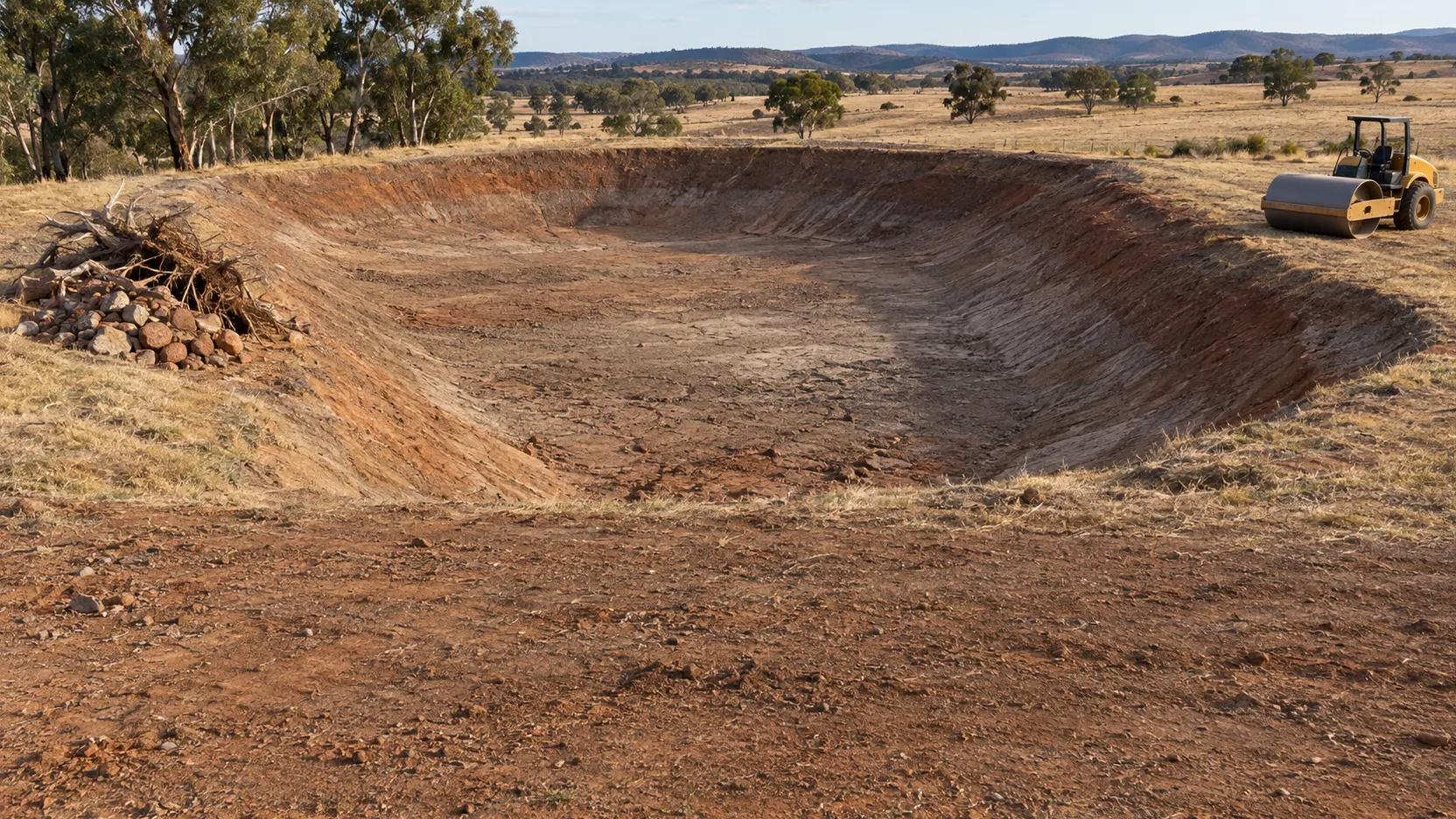
These are different installation sequences, not interchangeable names. Both drained-dam methods require emptying and drying the dam, clearing rocks and vegetation, and assessing the site before work. Bentonite Pro’s dam-sealing method guidance distinguishes suitable light or loam soils from suitable heavier soils. Select the method before arranging equipment or starting to spread material, rather than changing the sequence halfway through the job.
For a mixed blanket on suitable light or loam soils, prepare the soil, distribute bentonite, mix it into the upper 150 to 200 mm and then compact with a roller. NSW DPI describes this incorporation sequence in its mixed-blanket guidance; its generic method advice does not establish Bentonite Pro’s company application rate.
Will a pure blanket be covered before roller compaction?
For a pure blanket on suitable heavier soils, distribute bentonite over the prepared surface without mixing it into the base. Cover it with at least 100 mm of site soil, then compact the covered treatment with a roller. Increase the cover to at least 450 mm where stock have access. The NSW DPI pure-blanket guidance places protective cover before the final roller-compaction step.
Do not confuse spreading the bentonite with finishing the treatment. Plan the protective soil, access and work sequence before spreading starts, so placing cover does not become an improvised task after machinery has crossed the exposed layer. The finished treatment must remain continuous and protected from disturbance and erosion; isolated patches or successive layers are not automatically equivalent to a complete sealing plan.
Are you relying on broadcasting into a full dam?
Do not treat water-surface broadcasting as an assured shortcut around draining and preparation. NSW DPI describes it as “at best hit and miss” and does not recommend it because success cannot be assured. If the dam cannot be emptied, arrange a site assessment instead of using a broadcast dosing recipe. Slurry addition, broadcasting, mixed incorporation and pure blankets are distinct techniques; material does not automatically find and seal the leak.
Could refilling or later access disturb the treatment?
Refill gently to avoid eroding or disturbing the treated surface, then monitor performance. Plan how water enters and how stock or machinery will be kept from damaging the work. Do not promise a fixed hydration time, a particular sealing date or a guaranteed lifespan. If work must be staged, have a site-specific plan for maintaining a continuous treatment rather than assuming separate patches will connect themselves.
What should you confirm before work starts?
Use the following checks as questions for the person assessing and installing the treatment. A completed checklist is not certification that a dam is suitable or safe; it helps identify missing decisions before material is spread.
| Decision | Confirm before proceeding |
|---|---|
| Cause and suitability | The leakage assessment, soil suitability and reason for selecting bentonite. |
| Treatment boundary | The measured floor and relevant sloping walls, including any irregular areas. |
| Quantity | Mass at 30 kg/m², whole-bag rounding and any separately stated allowance. |
| Method | Mixed incorporation followed by rolling, or a pure blanket covered before rolling. |
| Protection | Cover, stock access, staged-work continuity and a gentle refilling arrangement. |
| Follow-up | Who will monitor water levels and assess unexpected loss or disturbance. |
What does the specification sheet actually establish?
Bentonite Pro supplies high-purity sodium bentonite fines, not the separate granular grade. The current Big Ditch Bentonite specification sheet lists nominal fine-grade particle size below 1.25 mm and typical montmorillonite content greater than 90% on an as-is basis.
Those are typical values for general information, not guaranteed specifications or evidence that a particular dam will seal. The sheet describes the material; it does not diagnose a leak, choose an installation method or guarantee a service life. Keep product selection, site assessment and construction decisions separate rather than treating a material property as a repair promise.
Frequently asked questions
Will adding more bentonite fix a failed treatment?
Not necessarily. Have the cause of continued loss, soil suitability, method and condition of the treated surface checked first. Extra material cannot be assumed to correct a structural defect, an unsuitable treatment or damage to a finished layer.
Does every bentonite method require mixing?
No. Mixed blankets incorporate bentonite into soil before roller compaction. Pure blankets keep bentonite separate from the base and require protective soil cover before roller compaction. Choose the method through site assessment, not by combining instructions from both.
Can I order before the treatment area is confirmed?
You can prepare an estimate, but confirm suitability, method and the full treatment boundary before committing to an order. Keep assumptions visible, especially sloping-wall area, whole-bag rounding and any allowance. Do not describe a preliminary quantity as a guaranteed sealing requirement.

Written by Angus Hughson, CEO, Big Ditch Dam Building Company. This guide provides general information; the appropriate treatment requires a site-specific assessment.
Want to avoid bentonite sealing mistakes before work starts? Contact Bentonite Pro to discuss the site, treatment method and preliminary quantity.