
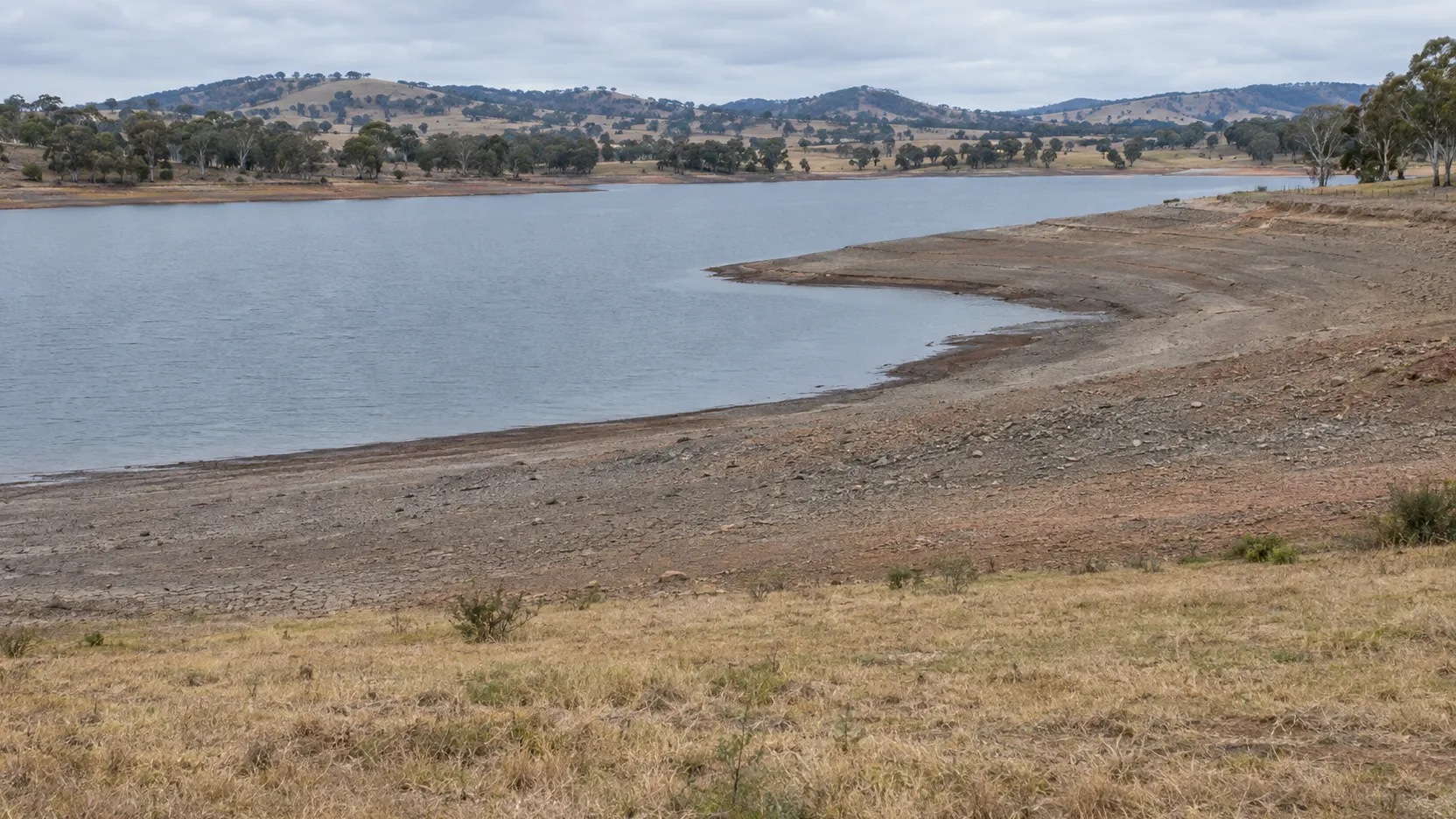
Short answer: A falling waterline alone does not prove your dam needs resealing. Check water use and evaporation, then look for persistent wet areas, new cracks, settlement or damage to the treated surface. Record what changes and arrange an assessment before ordering bentonite. Signs of structural distress need professional safety advice, not a routine sealing treatment.
A seasonal inspection is a chance to collect useful evidence before deciding on repairs. Keep the question practical: has water loss changed, where is water appearing, and has the wall or treated surface changed too? For a farm pond with no raised wall, the water-level record still matters, while the inspection should reflect its actual construction.
Seepage is water moving through soil or other permeable material. Resealing is work intended to reduce unwanted water movement through the storage’s treated surface; it is not a substitute for repairing an unsafe embankment, pipe or spillway.
Not sure whether bentonite suits your dam? The leaking dam triage check takes four questions and tells you whether to plan a drained treatment, get the site assessed, or have the wall checked first.
How can you tell whether a dam needs resealing?
Does a falling water level prove there is a leak?
No. The NSW DPI guide advises checking other losses, including evaporation and an accidentally open outlet valve, before diagnosing a leak. Its Leaking farm dams guide also makes clear that each site is different and general guidance does not replace qualified advice.
Start a dated record from a fixed, safely accessible reference point. Note rainfall, pumping, stock-water use and outlet settings alongside the water level. Compare observations under similar operating conditions rather than treating one hot, windy day or a pumping session as proof of seepage. Do not apply an invented universal millimetres-per-day threshold to decide whether to reseal.
Which visible changes should you record?
Record changes to both the storage and the surrounding ground. Dams Safety NSW’s small-dams safety guide identifies water levels, seepage, sinkholes, lush growth, settlement and cracking as inspection points. It also calls for checks around the inlet, waterline, wall, spillway and immediately downstream.
| Observation | Useful record | Next decision |
|---|---|---|
| Water level falling without an obvious explanation | Dates, level readings, rainfall, pumping and outlet use | Ask for a water-loss assessment before specifying treatment. |
| Wet or unusually green ground below the wall | Location, extent and photographs from a safe position | Have the possible seepage path assessed, rather than assuming a floor treatment will fix it. |
| New cracks, uneven crest, slumping or a sinkhole | Photographs and a description of changes, without entering suspect ground | Seek prompt dam-safety advice. Do not treat this as a routine bentonite order. |
| Exposed or disturbed areas on a previously treated surface | Location, visible disturbance and available repair history | Have the continuity and protection of the treatment checked. |
| Obstructed or eroded spillway | Location and photographs taken without entering flowing water | Arrange maintenance or professional advice appropriate to the defect; resealing does not resolve spillway capacity. |
Use this table to organise observations, not to certify the dam as safe. If a dam is failing and people may be in danger, Dams Safety NSW directs owners to call 000 immediately and, where safe, warn affected neighbours. Do not delay an urgent response to finish a checklist or request a material quote.
What should a seasonal inspection record contain?
How can you make the observations useful to an assessor?
A dated sequence is more useful than an unexplained photograph. Use the same safe viewpoints where possible, and separate what you saw from what you think caused it. Write “wet patch below the eastern wall” rather than “failed bentonite seal” unless the cause has actually been established. Send available construction and repair records with the observations.
- Record the date, water level, recent rain, pumping and outlet settings.
- Photograph the waterline and accessible banks from safe, repeatable positions.
- Mark suspected defects on a simple sketch without probing or excavating the wall.
- Note whether each feature is new, unchanged or visibly worsening.
- Provide repair history and ask the assessor which areas and soil conditions need investigation.
Choose follow-up timing with the assessor according to the defect and risk. A scheduled seasonal check must not become a reason to wait when something changes suddenly. Keep people, vehicles and stock away from suspect ground, and do not improvise drainage or excavation around a potentially unstable wall.
When should bentonite enter the repair plan?
What needs checking before you order material?
Confirm the cause of leakage, soil suitability and installation method first. Bentonite Pro’s dam-sealing method guidance sets out those checks and the limits of treatment. A record of water loss can help an assessment, but it cannot establish the correct method, the treatment boundary or the quantity by itself.
Bentonite Pro uses 30 kg/m² as its company application and preliminary ordering standard. This is not a rate specified by NSW DPI or by the product specification sheet.
Bentonite Pro supplies 1.2 tonne sodium bentonite fines bulk bags, each containing 1,200 kg. At the company standard, one bag provides material for 40 m² before allowance, a calculated coverage rather than a guarantee of sealing.
The Big Ditch Bentonite specification sheet lists nominal fine-grade particle size below 1.25 mm. Its properties are typical values for general information, not guaranteed specifications or proof that a particular dam is suitable for treatment.
Frequently asked questions
Does every wet patch mean the dam needs resealing?
No. A wet patch is an observation to investigate, not a confirmed diagnosis or a treatment specification. Record where it appears and how it changes, and have the source assessed before assuming bentonite is the remedy.
Can I add bentonite while the dam is full?
Do not rely on water-surface broadcasting as an assured repair. NSW DPI describes it as “at best hit and miss” and does not recommend it because success cannot be assured. If the dam cannot be emptied, arrange a site assessment rather than using a broadcast dosing recipe.
Should I buy bags from the visible water area?
No. Preliminary quantities use the total surface area to be treated, including the floor and relevant sloping walls, multiplied by 30 kg/m². Divide by 1,200 kg and round up to whole bags, with any allowance stated separately. Confirm the treatment boundary and site suitability before ordering.

Written by Angus Hughson, CEO, Big Ditch Dam Building Company. This checklist provides general information; the cause of water loss and the appropriate repair require a site-specific assessment.
Not sure whether your dam needs resealing? Contact Bentonite Pro to discuss the observations before choosing a treatment.